

16 | AUGUST 6 • 2020
Jews in the D
cover story
The Michigan Board of Rabbis
approved a policy on July 20 stat-
ing that High Holiday services
will be online only. According to
their statement, this decision is
based on a commitment to the
Jewish values of pikuah nefesh,
“safeguarding life,
” and sakanat
nefeshot, the prohibition of
“endangering life,
” as well as a
“preponderance of the best scien-
tific and medical advice that we
have.
”
At Young Israel of Southfield, a survey has
been sent to members to assess their prefer-
ences for the High Holidays.
“There is no question that the High
Holidays will feel different this year. But
whether ‘
different’
is good or bad
will depend largely, like always,
on the intentionality and soul-
fulness by which one approach-
es the experience rather than
whether the experience is online
or in-person,
” comments Rabbi
Aaron Starr of Congregation
Shaarey Zedek. The Conservative Rabbinical
Assembly has developed detailed guidelines
and legal forms with representatives of other
Jewish streams; these are available at
cjhighholidays.com/reopening.
WILL MEMBERSHIP DECLINE?
COVID-19 is also affecting synagogue
finances. Revenue from scheduled synagogue
events, now canceled, has been lost. In addi-
tion, fundraising events have been canceled,
although some congregations, such as Young
Israel of Oak Park (YIOP) and Young Israel of
Southfield, will hold virtual versions of their
annual dinners. YIOP’
s fundraiser will include
a kosher meal, home-delivered, and a virtual
comedy show.
Membership revenues also may be affect-
ed as some individuals question whether
dues make sense when on-site services and
programs have been curtailed or eliminated.
At Temple Beth El in Bloomfield Township,
Rabbi Mark Miller said that only a few indi-
viduals have raised that issue so far. The
temple is a service organization and personnel
costs are the biggest part of its budget, he
explained, and most people understand that.
However, Rabbi Yedwab said that “all
congregations are expecting some drop-off
because of the economic recession.
”
ALREADY CHALLENGED
While the pandemic has created major new
challenges for synagogues, membership trends
had been flat or declining for some years. (See
sidebar about the Detroit Population Study.)
There has been a continuing decline in
religious identification among American
Protestants, Catholics and Jews, as reported
by the Pew Research Center, which regularly
conducts surveys about religious attitudes.
This disaffiliation is strongest among younger
people.
There have been new efforts locally and
nationally to reach the Jewish community,
especially younger people who don’
t find syn-
agogue membership particularly appealing, as
well as initiatives to engage and retain existing
synagogue members.
Several years ago, Temple Israel began The
Well, an outreach effort for younger Jewish
individuals and families that focuses on
Shabbat and holiday celebrations, education
and social programs, all held in various loca-
tions outside the temple. The goal is to devel-
op connections and strengthen Jewish identity
and knowledge, which may eventually lead to
affiliation with a synagogue. A new director,
Rabbi Jeff Stombaugh, joined The Well this
summer.
In recent years, unrelated to COVID, some
Reform and Conservative congregations
across the country have been attempting to
retain members through small special interest
groups. This concept isn’
t completely new
— there was a chavurah movement years
ago and most synagogues have brotherhood
and sisterhood groups. However, the current
initiative is somewhat different. “People have
always had naturally occurring small groups
DR. RON WOLFSON: TEMPLES AND
SYNAGOGUES NEED TO “DEEPEN
ENGAGEMENT”
Prior to the COVID pandemic, Dr.
Ron Wolfson, Fingerhut Professor
of Education at American Jewish
University, said that many synagogues
and temples were challenged by flat or
declining membership. He is co-found-
er of Synagogue 3000, a nonprofit orga-
nization providing leadership training
to enhance synagogues, and author of
Relational Judaism — Using the Power
of Relationships to Transform the Jewish
Community, which he describes as a
handbook for Jewish congregations.
Dr. Wolfson cites multiple reasons
for congregational “retention and
recruitment issues.” Typically, fami-
lies join temples or synagogues when
their children are ready for school, but
today’
s young Jews are marrying at a
later age, delaying their potential inter-
est in membership. Also, the millennial
generation (for Christians and Jews) is
somewhat resistant to affiliations — for
religious participation and other aspects
of life.
Dr. Wolfson believes that congrega-
tions must shift from a “transactional/
programmatic focus to a relational
model” in order to maintain and
increase membership. He cites a failure
to “engage adults with clergy, educators,
staff and other friends.”
Wolfson tells of a temple member
who said, “I came to everything and
met nobody.” A temple program has to
connect people to each other or it’
s not
a sacred community, he said.
These connections can be achieved
through religious commitment, social
justice activities or friendships. Other
tactics include the creation of multiple
small groups within a congregation,
which is common to mega-churches.
Such groups can have a distinct brand
and identity. “They provide opportu-
nities to engage a younger generation
with no expectation that they become
members,” Wolfson said.
He also views preschools as support-
ive of “relational Judaism.” “Preschools
are a natural feeder into the life of the
congregations. A relationship is being
built with adults, including grandpar-
ents, and they create a group of kids,”
he said.
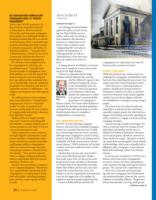
RIVARD STREET
Temple Beth El was the first Jewish congregation in
Michigan, formed in 1850. After meeting in a home
and then a rented space, the congregation purchased
this property on Rivard Street in Detroit, which
served as its synagogue building from 1861-1867.
continued from page 15
continued on page 18
Rabbi Aaron
Starr
COURTESY OF TEMPLE BETH EL