

30 | JULY 30 • 2020
W
riting out her emo-
tional reactions has
long been one way
of bringing personal insight and
solace to Cindy Frenkel, and
she often chooses poetry as her
expressive form.
As a child, Frenkel’
s inter-
est in creative writing, hers
and others, intensified while
attending Cranbrook Schools
during the late 1960s and into
the 1970s, and her interest
developed into a wide-rang-
ing career. She worked as an
editorial assistant at the New
Yorker in the 1980s and has
been an instructor at Lawrence
Technological University for the
past seven years.
As the last century moved
into this one, a series of overlap-
ping family tragedies, divorce
and death, repeatedly brought
Frenkel to her home desk as
the setting for writing about the
enduring impact.
Her decision to offer a group
of poems for publication —
some appearing in literary jour-
nals — succeeded last year, and
her first chapbook, The Plague
of the Tender-Hearted, will be
released by Finishing Line Press
in September. Besides telling
about the difficult
hurdles Frankel has
faced, the book is
offered as motivation
for others wanting
to advance beyond
sadness.
“I didn’
t want to
just survive all I expe-
rienced,
” said Frenkel,
61, a resident of
Huntington Woods. “I wanted
to thrive, and that’
s what’
s hap-
pening now. My work has given
me meaning. I wanted to teach,
and I wanted to write.
”
Frenkel, the only daughter
in a family with three older
brothers, explains that she was
raised in a loving way but was
discouraged from talking about
relationship difficulties and
troubling feelings. The conver-
sational focus of her parents
was on what people did, and a
youthful portrait by her dad,
which became the book cover,
keeps with that focus by show-
ing her at ballet.
“I wanted a deeper connec-
tion with people,
” Frenkel said.
“I wanted to talk about ideas
and feel that there was safety
in that exchange. My parents
avoided difficult subjects and
believed people shouldn’
t talk
about grief.
”
As Frenkel coped
with a brother’
s
addiction and suicide
amid her mother’
s
terminal illness, she
also was coping with
her own divorce.
The most important
part of her ability to
thrive was in being
motivated to raise her
daughter with understandings
she gained after her own frus-
trations.
Her poem “Raising her is
better than” lists outstanding
pastimes and ranks each day
of parenting above other dra-
matic experiences: the Holy
Wall in Jerusalem, cold water
on a sweltering day, French gar-
dens … In contrast, “How You
Said Goodbye” recalls the last
conversation with her beloved
brother.
“Part of writing poetry
became my way of processing
grief,
” Frenkel said. “I wanted
my brother’
s life to have mean-
ing, and if this poetry could
be presented in a way that was
compassionate, real and helpful
to someone, then the book was
worth doing,
”
Frenkel studied writing at
Bennington College in Vermont
before getting a bachelor’
s
degree at the University of
Michigan. Although enrolling
in master’
s studies at New York
University, she moved into a
degree program at Columbia
University because her father
encouraged Ivy League creden-
tials.
Important to Frenkel’
s studies
was attending classes taught by
award-winning favorite poets
— Galway Kinnell and Joseph
Brodsky. She has included some
of their instruction methods,
such as memorizing a favorite
poem, into classes she teaches,
some of which were in urban
elementary schools.
Frenkel’
s first book project,
100 Essential Books for Jewish
Readers, was a partnership
with Rabbi Daniel Syme, who
also experienced a brother’
s
suicide. In working together,
they moved away from family
problems and into a variety of
reviews.
Frenkel, who has written for
newspapers, submitted an arti-
cle about her late brother to the
JN in 2018, connecting to the
suicide of designer Kate Spade.
Wanting to reach out in many
ways to help others feeling des-
perate, she was on the founding
board of the group A Single
Soul, started by Rabbi Syme to
prevent suicide.
“I’
ve had the great privilege
of lifelong friends and even
some of my brother’
s friends
who were in recovery and really
heartbroken when he died,
” she
said. “They helped keep me
afloat after his death.
“I try to pay it forward for
all the people who have been
so kind to me, and this book
is about a woman claiming
her power. It’
s about my life
and having a voice. I think it’
s
a life-affirming manuscript in
that regard.
”
The Plague of the Tender-Hearted and
information about the author are avail-
able on her website, cindyfrenkel.com.
Arts&Life
poetry
“Part of writing poetry became
my way of processing grief.”
— CINDY FRENKEL
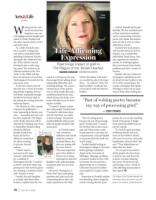
Poet brings impact of grief in
The Plague of the Tender-Hearted.
SUZANNE CHESSLER CONTRIBUTING WRITER
Cindy
Frenkel
P
b i
i
f
i f i
Life-Affirming
Expression