

JULY 16 • 2020 | 27
CHARLES SILOW SPECIAL TO THE JEWISH NEWS
Jews in the D
M
ichigan Gov.
Gretchen Whitmer’
s
Stay Home, Stay Safe
initiative was designed to help
save lives during the COVID-19
pandemic. However, for many,
being physically isolated from
others has created emotional
hardships as they are separated
from their families and loved
ones.
For many survivors of the
Holocaust, the difficulties of
social isolation can also be
emotional triggers that link the
present situation to memories
of being separated from and
losing loved ones during the
Holocaust.
It has meant a great deal to
survivors to receive phone calls
letting them know they are not
alone, that they are cared for.
Being in touch with survivors
has been an important sup-
portive project of the Program
for Holocaust Survivors and
Families (PHSF), a service of
Jewish Senior Life.
Through collaboration with
Jewish Family Service and a
special COVID-19 grant from
the Claims Conference, survi-
vors have been in contact with
one another in virtual groups
and through individual phone
calls. This communication helps
survivors know and feel that
they are not alone. Psychosocial
supports for Holocaust sur-
vivors have been significant
during this difficult time.
Relatedly, another socializa-
tion project was recently initi-
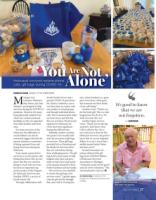
ated: the provision of gift bags
to survivors. These gift bags,
provided by Leo Eisenberg and
his family, let survivors know
they are cared about during
these challenging times. The gift
bags held various items to help
brighten their days and put a
smile on their faces and includ-
ed facemasks donated by Shari
Ferber Kaufman and her family.
The survivors were thankful
to receive the gift bags. One
survivor wrote, “I greatly appre-
ciate the gift and the thought
that came with it. During this
time, when loneliness is a great
part of our lives, it feels good
that someone out there thinks
of our well-being.
”
Another wrote, “Thank you
for the lovely gift. This is a chal-
lenging time for all of us. We
shall overcome this, too.
”
Another happy survivor
wrote, “Thank you for the big
surprise! I don’
t know what
I did to deserve this. It’
s so
nice what you’
ve done for the
Holocaust survivors. It’
s good to
know that we are not forgotten.
Believe it or not, I never had a
stuffed animal before! Better
late than never!”
Second Generation vol-
unteers delivered the gift
bags from CHAIM-Children
of Holocaust-Survivors
Association in Michigan.
“Doing this made me feel good,
”
said one of the volunteers. “The
real beneficiaries were us.
”
Dr. Charles Silow is director of the
Program for Holocaust Survivors and
Families.
PHOTOS COURTESY OF CHARLES SILOW
Holocaust survivors receive phone
calls, gift bags during COVID-19.
rv
s
ivors receive phone
during COVID-19.
Not
Alone’
Are
‘You
It’s good to know
that we are
not forgotten.
— SURVIVOR
Survivor Sandor Adler
enjoys the adult coloring book
that came in his gift bag.
JULY 30 • 2020 | 27