

28 | JULY 23 • 2020
Eretz
I
n the summer of 2010, native
Israeli and Harvard grad
Mishy Harman gathered
his belongings and his dog and
embarked on a 13,000-mile
road trip across the United
States. Just outside of Vicksburg,
Mississippi, he said, his life tra-
jectory changed. It was when
Harman switched from listen-
ing to books on tape and Bible
Belt radio to an episode of This
American Life.
As he listened, Harman
remembers being transport-
ed into the lives of different
Americans across the country.
In what he describes as an invig-
orating and dizzying moment,
he said his conception of
American reality was expanded.
“The first thought I had was
maybe we could do something
like this in Israel, create an
Israeli version of This American
Life, because Israel is this rich
human tapestry of so many
different traditions and back-
grounds and identities,
” he said.
Two years later, in the sum-
mer of 2012, after visiting TAL
studios in New York to learn
more, Harman and three child-
hood friends released the first
episode of their podcast, Israel
Story. At the time of its release,
Harman said about a dozen
close family members and
friends downloaded the first
episode.
Just a few months later,
Harman secured a prime-time
Friday afternoon slot on Galey
Tzahal, Israel’
s leading national
radio station. Now, in 2020, at
the start of their fifth season,
Israel Story has a production
team of 15 people and hundreds
of thousands of listeners.
Before starting the podcast,
Harman said he and his friends
had humble expectations for its
outcome. They aspired to share
multifaceted stories of individ-
uals from different cultures and
backgrounds — people who
might not otherwise get to inter-
act in an extremely fragmented
Israeli society. Harman said he
hoped that by eliminating a
visual element of storytelling, lis-
teners might be able to suspend
their judgments of the show’
s
guests just a little bit longer.
“Maybe you would be able
to listen to a story and forget
for the first 90 seconds that the
person is a Bedouin teenager
or an ultra-Orthodox grand-
mother, and just listen to them
tell a story and relate to them,
”
he said.
REACHING OUT TO
AN AMERICAN AUDIENCE
After the end of a successful first
season on Israeli public radio,
Harman saw a larger potential
for what started as a late-night
passion project. After writing
1,000 letters of inquiry to vari-
ous foundations in America, he
realized Israel Story would need
to be adapted to suit a larger
audience.
“That was the very first time
we had the somewhat coun-
terintuitive idea of making the
American version of the Israeli
version of This American Life,
”
he said.
With a grant from Steven
Spielberg’
s Righteous Persons
Foundation, Harman and his
team created new English sea-
sons of the podcast and formed
a partnership with Tablet
Magazine and the Public Radio
Exchange. With this adapted
show came the opportunity to
portray a more nuanced version
of Israel to an American audi-
ence.
For Skyler Inman, who moved
from the United States to Tel
Aviv in 2017, it’
s the attention
to detail on the podcast that
helps allow for these nuances.
Now a full-time producer on
Israel Story, Inman said that a
team member may spend six to
nine months working on a story
for one episode, among other
projects.
“From start to finish, there’
s
so much attention that goes into
every square inch of the tape,
a fine-toothed comb,
” she said.
“It’
s a pretty amazing experience
from a learning perspective.
”
ISRAEL STORY AND COVID-19
Amid a global pandemic, how-
ever, the Israel Story team has
had to come up with innovative
approaches to their carefully
produced podcast.
Harman said that COVID-19
has posed massive challenges
for the show, especially in terms
of fundraising. Originally, the
team had their annual world
tour scheduled for April and
May, which was eventually
canceled due to the pandemic.
Harman said this live tour usu-
ally accounts for about a third of
their annual budget.
“We were worried we were
going to run out of money,
” he
said. “We tried to think of every
possible way to keep the opera-
tion running.
”
Inman, who joined the pod-
cast in February, about a month
before the pandemic broke out
and Israel issued strict quar-
antine measures, said she has
been impressed by Harman
and other team-members’
cre-
ativity in the wake of the health
crisis. She said that one day in
April, Harman came up with an
idea — a 12-hour long cultural
extravaganza on Zoom.
Inman says that two sleepless
weeks later, on April 29, Israel
Story held its first “IsraPalooza,
”
an all-day 12-hour event in
which team members inter-
MADELINE HALPERT CONTRIBUTING WRITER
In its 5th season, podcast shares
lives of ordinary Israelis.
Israel Story
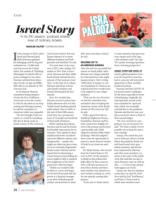
A 12-hour event held in
April by Israel Story.
ISRAPALOOZA
AVISHAG SHAAR YASHUV
Mishy
Harman