

upended people’
s lives. April and May saw
an increase in requests for help from the
Roof Over Head program, which helps
with rent payments. Requests for trans-
portation assistance also increased as peo-
ple who relied on public transportation or
rideshare apps to get to work began to feel
unsafe with their options.
“If we spend the next six months also
attracting more returning citizens, then
the year will be our highest by far, I’
m
sure, for grantees,” Schwartz said.
Because of the unique nature of Here to
Help, prospective grantees need to meet
several requirements before receiving
assistance. For example, if they’
re able to
work and they’
re applying for a grant, they
must be employed and able to show pay
stubs for the last four weeks. As Schwartz
says, the organization gives “hand-ups,”
not hand-outs.
“We can’
t give someone help with back
rent if they don’
t have any income because
next month they’
re still going to need
rent, and where are they going to get it
from?” Schwartz said. “So we look at what
we’
re doing as an investment in the grant-
ee — that they’
ll be fine moving forward.”
Not all the same requirements apply
to grantees for the Returning Hope
to Returning Citizens program. They
do hope to see that applicants have an
income, but “we don’
t list any particu-
lar requirements on that page, per se,”
Schwartz said. “We just want them to
email us and we’
ll take it from there.”
Here to Help used to work with state
agencies and local nonprofits to con-
nect with people who qualified for their
grants. Schwartz said they’
d go through
what he calls the “qualified advocate”
— a Department of Health and Human
Services employee or a social worker. But
several years ago, Here to Help decided
to put their grantee requirements in plain
text on their website. Now grantees can
email Schwartz and Here to Help staff
directly to apply for assistance.
“I can usually tell once we get that
initial email with the initial information
whether we’
re going to be able to help or
not, and nine times out of 10, if they qual-
ify … we’
ll be able to assist them,” he said.
RETURNING CITIZENS
Lionel Smith of Detroit is one of those
people who reached out to Here to Help.
He was connected with the organiza-
tion last summer through the Center for
Employment Opportunity to apply for
a grant through the Working Cars for
Working People program. A returning
citizen himself, Smith had found a job but
couldn’
t yet afford to purchase a car.
Working with Here to Help couldn’
t
have been easier, Smith said. There were
less than two weeks between the day he
initially applied for the grant and the day
he got to drive his car off the lot. And he
continued on page 16
JULY 23 • 2020 | 15
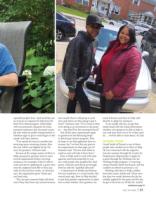
Kimberly Miller and
her grandson with
their new ride from
Here to Help.
ALEXANDER CLEGG/JEWISH NEWS
HERE TO HELP