

Looking Back
From the William Davidson Digital Archive of Jewish Detroit History
accessible at www.djnfoundation.org
The Legacy of the Phoenix and Redford Clubs
A
rthur Horwitz, pub-
lisher of the JN,
recently provided me
with a very insightful bit of
information. While he was
reviewing the usage statistics
for the William Davidson
Digital Archive of Jewish
Detroit History,
he noticed there
were 59 visits
to one particu-
lar page in the
Archive: page 8
of the March 12,
1920, issue of the
Jewish Chronicle.
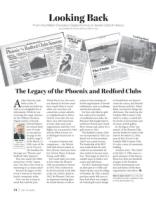
The headline for
the page was “Phoenix and
Redford Clubs Separate.”
This year marks the 100th
anniversary of this “separa-
tion,” but why is this event so
interesting to so many today?
Because the legacy of this
event is relevant to Detroit’
s
Jewish community today.
First, one has to keep in
mind that until the post-
World War II era, Jews were
not allowed to become mem-
bers of golf clubs or social
clubs, nor were they wel-
comed into certain suburbs
or neighborhoods in Metro
Detroit. Even after the war,
there were still restrictions
at some clubs and social
organizations until the Civil
Rights Act was passed in 1964
and the Elliot-Larson Act
in Michigan became law in
1977.
(A point of interest and
comparison — the Detroit
Golf Club did not admit its
first African-American mem-
ber, Detroit Mayor Coleman
Young, until 1986.)
Few social clubs were open
to Jews when the Phoenix
Club was founded in Detroit
in 1872. This is believed to
be the first Jewish social club
in the city. Until it closed in
1942, the Phoenix Club was
an important meeting place
for Jewish literati, as well as
a place to host meetings of
Jewish organizations or Jewish
celebrations, such as weddings
and bar/bat mitzvahs.
For Jews who liked to golf,
but could not be members
of established area clubs, the
Phoenix Club bought land in
northwest Detroit near Grand
River Avenue and Lahser for a
golf course in 1913.
The Redford Country Club
was incorporated in 1920. Leo
Butzel was its first president.
And it was a great success.
The leadership of the RCC
soon realized that the club
could not accommodate all
who wished to become mem-
bers. They began to look for a
suitable space to build a new
course and club house.
The RCC leadership found
an ideal spot at 13 Mile and
Inkster Roads, near the village
of Franklin. By 1926, a deal to
purchase nearly 400 acres of
farm land there was complet-
ed. Famed golf course design-
er Donald Ross was hired to
create the course, and Detroit’
s
most famous architect, Albert
Kahn, was hired to design the
club house. The result was the
Franklin Hills Country Club,
which is, today, a central hub
for Jewish social activities and,
of course, Jewish golfers.
So, the legacy of the “sep-
aration” of the Phoenix Club
and the Redford Country Club
cited in the March 12, 1920,
issue of the Chronicle is the
Franklin Hills Country Club.
It is also a story of community
building.
A feature story, “The Clubs,”
in the July 15, 1988, issue is a
good summary of this history.
Moreover, there are hundreds
of pages in the Davidson
Archives featuring the activ-
ities and history of the three
organizations cited above.
Want to learn more? Go to the DJN
Foundation archives, available for free
at www.djnfoundation.org.
Mike Smith
Alene and
Graham Landau
Archivist Chair
54 | JULY 16 • 2020