

JULY 16 • 2020 | 5
Views
jewfro
To Your Health
I
never met my mom’
s dad, but I think
about him when I go to the doctor. And
when I didn’
t.
He hired and mentored my pediatrician,
Dr. May Ling Lie Shuck, over the objections
of partners who thought a
Jewish doctor from Baltimore
named Manes Hecht was
diversity enough for their
practice.
At Johns Hopkins, he
studied under and remained
lifelong friends with Dr. Helen
Taussig, who founded the
field of pediatric cardiology and developed a
treatment for blue baby syndrome.
As his 1973 Jewish News obituary notes,
Dr. Hecht came to Detroit to head up the
Rheumatic Fever Clinic at Children’
s Hospital
following his tour of duty as a World War II
medical captain; in Detroit, he was president
of the Detroit Pediatric Society and a
founding staff member of Sinai Hospital.
Yet for all this rarefied work, what really
sustained Grandpa Manes over 40 years
practicing medicine, even as his own health
faltered, was the routine and the relation-
ships. He saw patients at his office in the
Fisher Building, then later the Huntington
Woods Professional Building, walking home
for lunch and carrying a leather doctor bag
for evening house calls.
Dr. Hecht would no doubt disapprove that
I went 20 years without having a doctor. Dr.
Shuck retired around the time I got chest
hair (I hope coincidentally). After that, I
was lucky and stupid enough to get by with
a bottle of hydrogen peroxide, Flintstone’
s
chewables and the occasional Z-pack.
I am pleased, as I think he would be,
that my stupid luck (caveman behavior vs.
caveman vitamins) eventually brought me to
direct primary care.
At first, direct, primary and care sounded to
me like three random words stuck together to
make ever more refrigerator magnet poetry
for the medical industrial complex.
To my pleasant surprise (and good
health), direct primary care is an antidote to
much of what causes us to spend nearly 20%
of our gross domestic product on healthcare
for a sociological syndrome of stress, strain
and stratification.
It’
s simpler to describe how direct primary
care works than how — let me count the
ways — traditional fee-for-service, even with
“good” insurance, does not:
I am a member of Plum Health Direct
Primary Care. Membership costs $49 a
month. Raquel Orlich is my doctor.
I guess she’
s other people’
s doctor, too. But
I can call, email or text (from my $50/month
phone) Dr. Orlich any
time I’
m having an
issue and, if she can’
t solve it remotely, she
can always see me that day or the following.
At one point, there were some balloons
celebrating Dr. Orlich’
s 300th patient.
Ultimately, she’
ll have around 500. That
seems like a lot, I thought, especially
compared to my prior impression that I was
her only patient.
The average family physician has 2,400
patients. They see 24 a day, each for about
20 minutes, about half of which might be
spent on “charting” their electronic medical
records. But it has to be face-to-face (or face-
to-chart) or it won’
t be billable to insurance.
Direct primary care does not accept
insurance. At first, paying dollars (or HSA
or FSA or Bitcoin or seashells) directly for
healthcare seems inefficient when you
have employer-provided coverage. Until
you realize there’
s no co-pay, co-insur-
ance, deductible, out-of-pocket maximum,
pharmacy benefits management company,
in-network, out-of-network, pre-authoriza-
tions, pre-existing conditions, pre-notifica-
tions, death panels, etc.
And, as is typical with direct primary care,
there is no cost for visits to Plum Health.
My kids are now Plum Health members
for $10/month each, following A Tale of Two
Splinters:
Before direct primary care, Judah got a
splinter in his foot that I couldn’
t get out. We
did the responsible (parental and, it seemed,
financial) thing and took him to Beaumont
Urgent Care. After waiting around with a
weekend crowd whose issues were conspic-
uously more urgent, if not ER gruesome,
they got the splinter out, took our insurance
information and sent us on our way.
Then — dog with preexisting condition
of being dog bites man with high-deductible
plan — we got a bill for over $500. When I
called to inquire, the nice lady on the phone
reassured me that the “actual” cost was some
$1,200, but Blue Cross Beaumont synergy
something something you’
re welcome.
Not wanting to be left out, Phoebe got
a splinter in her finger recently. We texted
“Dr. Raquel.
” She wrote me right back with
her availability. I brought Phoebe to the
office at Michigan and Trumbull. Free street
parking. Splinter gone. Respectable Band-Aid
selection. No charge. And now Phoebe wants
to be either a doctor or Great Dane when she
grows up.
Grandpa Manes (whose great-grandchil-
dren will be caught up on their shots by the
end of the month) loved chamber music.
Perhaps it reminded him of what he aspired
to in his doctor-patient relationships. Not
composing or conducting — not virtuosic
solo performance — but creating space and
tuning your ear as much as your expertise to
the pursuit of humble, healthy harmony.
Ben Falik
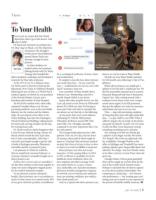
Dr. Raquel removes
Phoebe’
s splinter.