

Views
10 | JULY 16 • 2020
guest column
A Monumental Shame
I
magine this scenario: A
Jewish American family
takes a driving vaca-
tion. They take the Herman
Goering Freeway to the
Joseph Goebbels Bridge,
where they enter Adolf
Eichmann County and spend
the night at the Rudolf Hess
Hotel.
Sounds
absurd, right?
Now let’
s
replay that by
substituting a
Black family
and change the
names of the
places they pass:
Imagine a Black family
driving over the Jefferson
Davis Freeway, across the
Edmund Pettus Bridge,
entering Nathan Bedford
Forest County and staying
overnight at the Robert E. Lee
Hotel.
Each of those locations
are real places. Most white
people wouldn’
t think twice
about those names, not out of
racism but out of ignorance.
But take a moment to
consider the reality of who
those people were:
• The Jefferson Davis
Highway is named after the
president of the Confederacy.
He oversaw the rebellion
against the U.S., staked his
entire career on preserving
slavery, stating that B
lacks
are “inferior” and “fitted
expressly for servitude.”
• Edmund Pettus, whose
name adorns the famous
bridge in Mississippi, was
the Grand Dragon of the
Alabama Ku Klux Klan
during a time in which
Alabama led the nation in
lynchings.
• Forest County is named
after General Nathan Bedford
Forest, who became the first
Grand Dragon of the national
Ku Klux Klan.
• General Robert E. Lee
has a modern-day reputation
as an honorable warrior.
But he was a fanatical white
supremacist whose treatment
of Black people was par-
ticularly harsh. Lee’
s army
would regularly capture free
Black Americans and send
them to the South to become
someone’
s property. As a slave
owner, he sometimes chose to
beat his slaves himself. One
of his slaves, Wesley Norris,
once remarked that Lee’
s
punishment was especially
severe, saying that Lee was
“not satisfied to simply
lacerate our naked flesh.”
The Confederate States
of America existed solely to
preserve slavery. It declared
war on the United States just
to preserve the institution,
which ultimately resulted
in 620,000 deaths, more
than every other U.S. war
combined. Its very consti-
tution explicitly protected
slavery.
Yet today throughout
the South, the landscape
is littered with tributes to
Confederate leaders. There
are over 1,500 Confederate
statutes, over 200 schools, 10
military bases, and scores of
counties, hotels, diners, lakes
and mountains.
The debate over renaming
monuments and places is
currently raging. It’
s a messy,
controversial debate that
America needs to work out
and, in time, it will. But
Jews — a people who know
persecution far too well —
should approach this debate
with a profound sense of
empathy. Our ancestors
were often surrounded by
anti-Semitic symbols. Today,
in photos of this, we can
instantly feel their pain and
outrage. We should thus be
quick to condemn any display
of such symbols today, par-
ticularly those honoring
Confederate leaders, a group
who dedicated their careers
to enslaving an entire race of
people.
American Jews indeed face
anti-Semitism today, but we
don’
t live with (and can’
t even
imagine) seeing symbols all
around us named after rabid
anti-Semites. But still, we
should be able to easily grasp
how outrageous and demor-
alizing such symbols are to
Black America. We should
understand and support our
fellow Black citizens, more
than any other group of
people. Our camaraderie on
this issue should be powerful
and instinctual.
The debate over
Confederate monuments and
places will continue to divide
Americans for some time. But
it shouldn’
t divide the Jewish
community. We should
be solidly unified behind
the removal of all things
Confederate. Let them reside
in a museum, where they
belong. This should not be a
political issue for us; it should
be a visceral one.
Black Americans have every
right to feel pain and anger by
the presence of memorials to
people who wished to enslave
their ancestors. Jews would
be in an absolute uproar if
we had to witness tributes to
the leading anti-Semites of
the past. If we become callous
to this injustice, we not only
betray Black Americans, but
the lessons of our Jewish past
and the values we wish to
pass onto our children.
Mark Jacobs is the AIPAC Michigan
chair for African American Outreach,
a co-director of the Coalition for
Black and Jewish Unity, a board
member of the Jewish Community
Relations Council-AJC and the direc-
tor of Jewish Family Service’
s Legal
Referral Committee.
Mark Jacobs
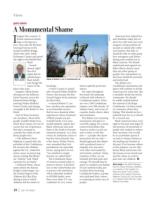
Statue of Robert E. Lee in Charlottesville, Va.
WIKIPEDIA