

JULY 9 • 2020 | 5
Views
for openers
Not A Singular Message
We may have heard that
“More is better.” In deal-
ing with our
English lan-
guage, however,
we learn that
making “more”
can be con-
fusing. There
seems to be lit-
tle consistency
when forming plurals. (Yes,
there are “rules,” but the
exceptions can be daunting.)
Do not go by sound or
similarity of spelling. Booth
will be booths, but tooth
becomes teeth. More than
one boot? Boots. More than
one foot? Feet! (Beet would
not work for boot because we
have already granted a red
vegetable with that name.)
One mouse is unnerving;
several mice mean an infes-
tation as well as confusion.
This also works for louse and
lice. However, you can see
one moose or many moose
— no change. (Mice won’
t
work here as a plural since
we have given the rodents
that form.) One roof, many
roofs; one hoof, however,
leads to many hooves.
Some of our words change
form altogether. One child,
many children; one person,
many people. If you are try-
ing to work with a word that
has come to us from Latin,
you will end up with one cac-
tus, many cacti. One fungus
can lead to many fungi. Just
so, one hippopotamus leads
us to several hippopotami.
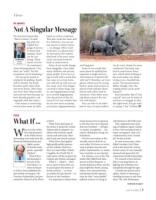
(See the picture of the rhi-
noceri?) Is it any wonder that
we are now most accepting
of cactuses, hippopotamuses
and funguses?
Some of our words that
seem plural in spelling but
represent a single item are
still treated as if plural (still
with me?) Therefore, we treat
glasses (item used for seeing
better), pants and scissors as
plural words and give them
plural verbs when used in
sentences. (One other warn-
ing about scissors: Do not
run with them!)
You can refer to an index
but be wary of many indices
(in-de-cees). Ready for more
confusion? One basis may
lead to many bases (base-
ees), which when looking at
the word makes one think
of places on a baseball dia-
mond. The pronunciation
differs though. (See why
reading aloud can be prob-
lematic?)
Just remember that if “one
is good” may not be better if
you have to struggle to find
the right word. Just get used
to saying “a lot” of them.
continued on page 6
Sy Manello
Editorial
Assistant
essay
What If …
W
hat if, in the 1930s,
Jews had protested
at the White House
demanding more help from the
Roosevelt administration and
higher quotas
for Jewish immi-
grants, especially
children?
What if Jews
had launched a
boycott of the
Ford Motor Co.
when its found-
er, Henry Ford, published his
anti-Semitic newspaper, The
Dearborn Independent, and pro-
moted the Protocols of the Elders
of Zion?
What if Jews had taken to
the streets to picket the United
Nations after it adopted a res-
olution that Zionism equals
racism and took many other
anti-Israel, anti-Jewish actions?
What if Jews had applied
high-profile public pressure
on the Catholic Church to
force it to take Father Charles
Coughlin, the World War II
radio priest, off the air given his
virulent anti-Semitic messages?
What if … what if … there
are so many of these that can
be posed given the history of
Jewish activism — or more
accurately the lack thereof — in
the face of anti-Semitism.
It is important to dissect these
issues because Jews in general,
to this day, have never learned
that anti-Semitism — all bigot-
ry, racism, xenophobia — can
only be defeated by strong con-
frontations.
We have never done so his-
torically, and we don’
t do so
even today. We frown on tactics
such as pickets, boycotts and
public condemnation, no matter
how virulently we are attacked.
For instance, even in the ’
30s,
leaders like Hillel Kook (also
known as Peter Bergson), a
Zionist political activist, and the
playwright Ben Hecht, among
others, were ostracized from
mainstream Jewish organiza-
tions for their “unacceptable”
political activism in trying to
call attention to the Holocaust.
They organized mass meet-
ings at Madison Square Garden
in New York and placed ads in
major newspapers, only to be
condemned by more “moder-
ate” Jewish activists.
In more recent years, when
Rabbi Avraham (Avi) Weiss
took to the streets for various
Jewish causes, he was, basically,
shunned and ignored by the
mainstream Jewish body politic.
We seemed to have learned
little in our long history of
fighting anti-Semitism and
xenophobia through the ages.
Consider the present atmo-
sphere, which is witnessing a
troubling increase in anti-Sem-
itism. The Anti-Defamation
Berl Falbaum