

S
purred by the over-
whelming attendance
at two recent Hatzalah-
organized blood drives, a
third, held on May 31, drew
nearly double the number of
individuals than the first two
combined.
All three were aimed at
helping those suffering from
COVID-19 and hopefully pre-
venting the virus from affect-
ing others.
The first two drives tested
only those who recovered
from the illness, had been
exposed or had symptoms,
with the hope of identifying
individuals with antibodies
that could potentially help
others. Nearly half of the 400
blood donors were found to
have levels of antibodies need-
ed to donate plasma for sci-
entific trials and treatment of
those who have the virus.
At the most recent drive,
the 350 donors who came
out included some with the
same COVID history but also
individuals with no diagnosis,
symptoms or exposure. Blood
was taken as part of a vaccine
development/virus progression
study, created for the develop-
ment and study of COVID-19
vaccines and to enable further
research toward more effective
treatment. The samples will be
used in the study of vaccine
development, as well as how
COVID-19 infects and spreads
across a region or community.
The first two drives were
organized by the Oak Park-
based Hatzalah of Michigan-
Emergency Medical Services.
At the May 31 drive, they col-
laborated with the Southfield
Fire Department.
Captain Melissa Medici, the
fire department’
s EMS coor-
dinator, who volunteered as
a phlebotomist at a previous
drive, contacted Hatzalah
about working together, said
Nachy Soloff of Southfield, a
Hatzalah volunteer and blood
drive organizer. “She opened it
up to a wider platform.”
Members of Hatzalah and
the fire department drew
blood in tented areas outside
the Southfield Public Library
from donors who waited in
their cars until called.
“Other communities also
held this type of drive, but
we are the only ones in the
national (Hatzalah) move-
ment to bring in these types
of numbers,” Soloff said. “Our
relationship with the city fire
department is a reflection of
this.
“In addition to new donors,
those tested for antibodies at
previous drives were eligible
to donate again at this most
recent one. We had people
who were so super-motivat-
ed to help others that they
donated before, and when they
heard about this drive, they
came back again.”
Jews in the D
SHELLI LIEBMAN DORFMAN CONTRIBUTING WRITER
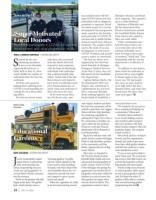
A member of the
Southfield Police
Dept., with Southfield
Fire Dept. Chief
Johnny Menifee at
the blood drive.
NACHY SOLOFF
J
ewish sustainability organi-
zation Hazon is partnering
with environmental edu-
cation nonprofit Big Green to
create new “giving gardens” in
several Metro Detroit communi-
ties this summer.
Work on the gardens officially
began in late June. The garden
beds, which already exist as
“learning gardens” at public
schools, will be planted by Big
Green staff in cities including
Ferndale, Oak Park, Hazel Park
and Southfield. Hazon has vol-
unteered to provide the seeds
and compost to grow carrots,
beans and squash.
When the vegetables are ready
to be harvested starting around
mid-August, students and fami-
lies from the community will be
invited to pick their own veggies.
Hazon will then help distribute
the remaining vegetables by
parking their Topsy Turvy Bus in
the community so families can
come collect the free produce.
Whatever is left after Hazon’
s
distribution will be donated to
local food pantries.
Big Green will also work with
online farmer’
s market Michigan
Fields to help distribute produce
in the community, said Ken
Elkins, regional director of Big
Green Detroit.
Big Green, co-founded in
2011 by Elon Musk’
s brother
Kimball Musk, builds and runs
educational learning gardens in
public schools. When COVID-
19 hit Michigan this spring, the
organization moved their learn-
ing garden curriculum online for
students to access at home, but
their gardens sat empty when
schools closed in March. The
organization wanted to find a
way to put them to use.
“We wanted to do our part as
far as assisting and helping our
communities,
” Elkins said.
Similarly, Hazon shifted its
focus toward helping commu-
nity members plant and grow
their own produce with their
Relief Garden Initiative when the
pandemic began. The program
ended on June 5.
Wren Hack, director of Hazon
Detroit, said her organization
already had seeds to give away
from their relief garden initiative,
and their bus made for a conve-
nient distribution center.
“It was an easy partnership to
form,
” Hack said. “It’
s so hearten-
ing to know that [Big Green] can
activate those gardens and just
help people with their meals.
”
Twenty of Big Green Detroit’
s
52 school gardens will be repur-
posed as giving gardens, Elkins
said. He hopes the other 32
gardens will be able to continue
with normal learning garden
programming this fall.
18 | JULY 2 • 2020
‘Super Motivated’
Local Donors
Hundreds participate in COVID-19 vaccine
development and virus progression study.
Educational
Gardens
Big Green, Hazon partner to grow
produce at Metro Detroit schools.
MAYA GOLDMAN CONTRIBUTING WRITER
COURTESY OF SARI CICUREL
Hazon’
s Topsy
Turvy Bus