

10 | JULY 2 • 2020
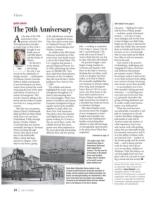
Palais Albert Rothschild, Vienna, Austria. It was
occupied by Adolf Eichmann during the annexation of
Austria, and the contents were looted by the Nazis. The
heavily war-damaged building was demolished in 1954.
Some of the items from the palace were eventually
recovered by the Rothschild family, who then donated
them to the Museum of Fine Arts in Boston.
Views
A
s the date of the 70th
anniversary of my
parents’
arrival in New
York approached, and after
so many trips to New York, I
thought it was
finally time to
visit Ellis Island
and the Statue of
Liberty.
On the ferry
to the islands
and during
the visit, I was
struck by the multitudes of
foreign tourists — catching bits
of Chinese, French, German,
Hebrew, Italian and Spanish.
It was heartening to see these
visitors from around the world
witnessing the best of the spirit
and history of America as a
nation of immigrants. This
was the America taking in the
bereft and the broken to build
new lives in a young and free
country.
After the war, my parents,
Manya (Maria) Waskobujnik
Balaj and Boruch (Ben) Balaj,
made their way west from
Chelyabinsk, USSR, through
Russia, Ukraine, Poland,
Czechoslovakia and Austria,
eventually arriving in Germany.
When traveling through
Vienna, they spent several
days in the Rothschild
Palace, which had been
opened to refugees. They
slept on the floors, gazing
at the splendorous remnants
of a once magnificent home.
They then spent several years
in Displaced Persons’
(DP)
camps in Wasseralfingen and
Wetzlar, Germany.
An exhibit at the Ellis Island
Museum reminded me of the
reason they were finally issued
a visa to the United States. The
U.S. Congress had passed a
special Displaced Persons Act
in 1948, authorizing the admit-
tance of 200,000 DPs. They
then sailed from Bremerhaven,
Germany on the US military
ship, the General Harry Taylor,
landing in New York on Nov.
7, 1949.
The exhibits and photos
highlighted the many waves of
immigrants throughout U.S.
history, documenting their
lives and struggles. There were
photos of Southern and Eastern
European immigrants living in
squalor and poverty, huddled
together in small, dark, run-
down New York tenements.
The photos show the haunted
and frightened faces of immi-
grants working 10-12 hours a
day, six-seven days a week. The
exhibits showed that immi-
grants were often employed in
the most physically demanding,
difficult, dirty and low-paying
jobs — working as carpenters
(“$3.75/day”), miners (“$2.50/
day”), and farmhands (“$5/
week with room & board”).
And to think that this was bet-
ter than what they left behind!
My parents bought a used
Singer sewing machine in
Germany and loaded it with
them on the ship to America,
thinking that my father could
work as a designer and shoe-
maker, as he had in Poland.
He eventually established his
own business in Detroit, toiling
those long, hard immigrant
hours. Born in 1915 in a one-
room, clay-floor house in the
kleyn shtetl (small town) of
Koretz, Poland, my father even-
tually moved his own family to
a beautiful four-bedroom home
in suburban Michigan.
Ellis Island displays many
documents about the struggles
of new immigrants to learn
English and assimilate into
American life, building their
families and pushing their
children to take full advantage
of unimaginable opportunities
in the places from which they
originated.
Barbara S.
Balaj
ing cause — fighting for justice
and the lives of Black people
— includes a point of personal
tension — it is time to make
more dialogue and not the time
to burn bridges you didn’
t help
build, nor the time to dismiss the
reality that within this movement
there are family and friends. It is
because we are a moral people
that we must stand up for Black
lives, like we and our ancestors
have in the past.
Anti-racism is the practice
of identifying, challenging and
changing the values, structures
and behaviors that perpetu-
ate systemic racism. I believe
becoming a nation of anti-racists
is our Sinai moment (God calling
us to action) of today. Practicing
anti-racism can be done Jewishly
— in accumulative acts of hes-
hbon hanefesh (taking personal
inventory — or checking your
own and your loved ones’
bias-
es), gimmulut chassadim (the
giving of loving-kindness) and
in tzedek, tzedek tirdof (justice,
justice, you shall pursue).
When the work becomes
uncomfortable, remember it will
pale in comparison to the dis-
comfort that Black, Indigenous
and people of color feel in
America under the shadow of
white supremacy. Root your
anti-racism work with guiding
values that are inherently Jewish
but intensely universal as well. It
is in the ability to balance both
our internal work — matters of
the Jewish people and the Jewish
faith — and in doing external
work for those who will see
us as we see them, children of
Abraham. With this balance we
can thoroughly heed our God-
given call to do our part in creat-
ing a moral and just society.
Peruse this list for some anti-rac-
ist resources: https://tinyurl.com/
yaka99u8. Ariana Mentzel is the
managing director of the Detroit
Center for Civil Discourse, a nonprofit
organization with the goal of creating
a space for meaningful and effective
conversation between peoples of dif-
fering ideas and experiences.
ANTI-RACIST from page 6
Manya Waskobujnik Balaj
and Boruch Balaj, April 20,
1946, Chelyabinsk, USSR.
guest column
The 70th Anniversary
PHOTOS COURTESY OF BARBARA BALAJ
continued on page 12
The caption reads: “M.S.
General Harry Taylor in
Bremerhaven [Germany]
before departing for
America.” The ship now lies
at the bottom of the Atlantic
Ocean near Key West,
Florida, where it functions
as the world’
s second
largest artificial reef.