

36 | JUNE 25 • 2020
Health care heroes today refl
ect
physician heroes of the Holocaust.
Health
E
ven before the coronavirus spread disruption,
fear and death, there was a noticeable shortage
of hope and purpose among many Americans.
Declining life expectancy among several groups was
attributable to high rates of suicide and drug over-
dose. Physicians, nurses and public health advocates
were already on the frontlines of these battles, well
before the COVID-19 pandemic shined a bright light
on just how essential health care workers are, not just
for our health, but for our sense of hope.
During this difficult period of history, one “feel
good” moment we experienced was the applause
given to health care workers as they left the hospital
when they completed their shifts. They not only
used their expertise to care for the afflicted, they also
demonstrated to the rest of us virtues of selflessness,
generosity and courage in the face of risk.
Further, they remained committed to the virtues of their profes-
sions even when we failed them, when we failed to follow through
on our applause with proper personal protection equipment, appro-
priate compensation or job security.
In their commitment to the health of their patients and, indeed,
to all the health of society at large, these health care workers partic-
ipated in a tradition too rarely recounted, a tradition of moral cour-
age and virtuous resistance. The health care heroes from the past
cannot only place the work of our current health care workforce in
its proper cultural and historical place, but can also give us hope for
our future.
HEROES OF THE PAST
On this 75th anniversary of the liberation of Auschwitz, and as we
eagerly await a coronavirus vaccine, we can look to the example of
Dr. Rudolph Weigl, who, during the period of the Holocaust, dis-
covered at an institute in Lvov the first vaccine against typhus. This
non-Jewish zoologist saved many lives at great risk to his own when
he smuggled this vaccine to Jewish physicians in the Lvov ghetto
and in Auschwitz.
Other stories of physicians caring for patients in the ghettoes and
camps help us figure out not only how to move away from evil, but
also what it means to turn toward the good.
Mark Dworzecki recognized and documented the historical
moment he was in, not only preserving what might otherwise have
been lost, but also encouraging others to capture their own stories.
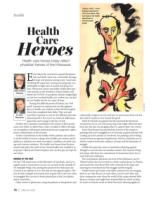
Karel Fleischmann documented the horrors of the camps in
paintings that were smuggled out of Germany at great personal risk.
Leading up to his murder at Auschwitz, his paintings and writings
turned toward an apparent hopelessness. But his continued acts of
artistic creation betray the resilience of hope and the humanity of
struggle.
Gisella Perl spent her years in Auschwitz scheming against
Mengele to save the lives of countless women. Her memoir brings
into sharp relief how her commitment to humanism drove her to
such bold acts of defiance.
The most famous physician survivor of the Holocaust was Dr.
Viktor Frankl, who was revered as a healer and protector in Terezin
and Auschwitz, and whose life’
s work centered on the hope and
meaning he wrenched from the struggle and the tragedy.
Frankl tried to give hope to his fellow prisoners by encouraging
them to act with decency to each other, care for each other and
show compassion even when the world of the camps showed little
decency to them and might have fostered little for which to hope.
So much of what he wrote in Man’
s Search for Meaning applies to
YAD VASHEM
“Autumn 1943,” a work
by Karel Fleischmann
of Dr. Erich Munk, who
was head of the health
department in
Theresienstadt
Ghetto
Rabbi Herbert
Yoksowitz
Dr. Jason
Wasserman
Health
Care
Heroes