

S
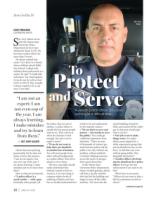
gt. Cary Glazer serves
with the Wayne State
University Police
Department in the Crime
Abatement Team (CAT). He
has been a police officer for
more than 19 years.
He always wanted that
career. “
As a favor to a friend,
whose children attend Hillel
Day School, I talked with
students about policework as a
career,” he said. “I would joke
with them: ‘
See what happens
if you do not do well on your
LSAT or MCAT.’
But, actually,
I always wanted to be a cop
since I was little.”
Glazer discusses policing
passionately, but he does not
claim to know the answers.
“I am not an expert; I am
not even cop of the year. I
am always learning. I make
mistakes and try to learn from
them.”
Here is what he has learned:
• “A police officer is a
social worker — with a gun.
Generally, when people call
the police, they are out of
options. A police officer is
usually the last person people
want to see. They call on us
when the situation is bad
enough. Our job is not to
make it worse.”
• “If you do not want to
help, then you should be
in another line of business.
You will meet people from
other cultural backgrounds
as a police officer. Your job is
always to serve them.
We Jews, especially, should
really understand that.
Nobody wanted us here in
America. I am not trying to
compare relative levels of
suffering of blacks and Jews,
but we should understand how
it feels to be not understood
by the majority culture.”
• “We are there to serve and
protect — but mostly to serve
the public.” You could get
a different impression from
television. “There are tens
of thousands of contacts per
week between police and the
public every day without any
problem, without publicity
or fanfare: Helping someone
across the street or giving a
driver good directions.”
At the Wayne State
University Police Department,
Glazer recalled getting a phone
call from a faculty member
who had left the building and
forgot to turn off the coffee
machine. “We went into the
closed building, found his
office and turned off the coffee
pot. Is that part of policing?
That is service.”
• “Our job is not to make
things worse. If a police
officer posts support for a
white supremacist group, that
person should not stay on the
force. To feel that way, even
without going public, they
disqualify themselves.”
• “A police officer who beats
anyone should not be a police
officer. Don’
t go into law
enforcement if you want to do
that.”
When force is necessary:
“Officers do not want to take a
life but sometimes are left no
choice.”
continued on page 26
LOUIS FINKELMAN
CONTRIBUTING WRITER
Jews in the D
22 | JUNE 25 • 2020
“I am not an
expert; I am
not even cop of
the year. I am
always learning.
I make mistakes
and try to learn
from them.”
— SGT. CARY GLAZER
A Jewish police offi
cer discusses
policing at a diffi
cult time.
A J
i h
li
ffi
di
Protect
Serve
and
To
Sgt. Cary
Glazer