

18 | JUNE 18 • 2020
Should Synagogues
Reopen?
Jews in the D
P
erhaps it’
s because pikuach nefesh, the
saving of life, is the ultimate Jewish
value — overriding all other com-
mandments except the prohibitions against
murder, idolatry and sex crimes — that few
synagogues and temples in the Detroit area
are reopening for services.
And perhaps it’
s because Orthodox
congregations have not, in general, held
services using Zoom or other remote access
programs — certainly not on the Sabbath
or holidays when they do not use electrici-
ty — that they have been the first to restart
in-person services.
Michigan’
s Orthodox Vaad HaRabonim,
or rabbis’
council, issued a letter May 21
providing guidelines congregations can use
to safely start minyanim — assemblies of at
least 10 — for services, noting that specifics
should depend on the size and layout of
each synagogue and the age and risk factors
of members.
All minyanim, whether indoors or out-
doors, must, according to the Vaad’
s guide-
lines, include the maintenance of social dis-
tancing and the wearing of masks. Anyone
over 65 should not participate without
permission from a physician. Services inside
homes are not permitted. Each congrega-
tion should appoint a monitor to ensure the
guidelines are being followed.
With these guidelines in mind, Dovid Ben
Nuchim, an Orthodox synagogue in Oak
Park, resumed daily services on May 27.
Children under 13 are not permitted, and
there is no open women’
s section. Everyone
must wash or sanitize his hands upon entry.
Those wanting to participate need to request
a spot in a particular minyan and fill out a
form agreeing to abide by the
guidelines.
Keter Torah, the Sephardic
synagogue in West Bloomfield,
started holding morning ser-
vices on Memorial Day week-
end. The first Shabbat they had
about 15 men; on Shavuot, 19
men and two women attended, said Rabbi
Sasson Natan.
The congregation is not allowing chil-
dren or anyone over age 70 at services. All
congregants must wear masks and gloves
and sit so there are at least three empty seats
between individuals. Windows and doors
are kept open in the synagogue to encourage
air circulation.
Rabbi Sasson reads the Torah, and anyone
honored with an aliyah stands at the back of
the bimah so he can see — but not touch —
the scroll.
The rabbi sees a benefit unrelated to the
coronavirus in the mandate to wear masks.
“Now we have a reminder that tells us do
not talk in the sanctuary unless it is really
necessary,
” he said.
Rabbi Yechiel Morris of Young
Israel of Southfield says his
congregation may try to reopen
in mid-June. “The Orthodox
Union has suggested waiting 14
days after any reopening date
suggested by the governor to see
if there’
s an uptick (in COVID-
19 cases),
” he said. “We will wait
to see how things play out in Michigan.
”
Conservative and Reform congregations
are in no hurry to reopen. Most have been
doing daily and Shabbat services online, and
many see a higher attendance at the virtual
minyanim than they experienced
in person. Rabbi Aaron Starr
of Conservative Congregation
Shaarey Zedek in Southfield said
their average daily minyan atten-
dance has nearly tripled.
Rabbi Robert Gamer of
Conservative Congregation
Beth Shalom in Oak Park also
said daily minyan attendance
has increased. The congregation
started doing Sunday through
Friday evening services by
Zoom in March and added daily
morning minyanim in mid-
May. The congregation has been
live-streaming Shabbat morning
services for almost five years, and in mid-
May they returned to doing so from the
synagogue’
s bimah; only the rabbi, Cantor
Sam Greenbaum and Torah reader Howard
Marcus are present.
At Reform Temple Beth El in Bloomfield
Township, the clergy and lay leaders are
evaluating a number of possibilities, includ-
ing allowing private events such as b’
nai
mitzvah starting in August, holding outdoor
services on Friday night and having clergy
lead Friday night virtual services from the
temple, rather than from home. Temple
Israel in West Bloomfield’
s building is closed
to the public but the temple hosts a number
of services and educational programs on
Zoom, Facebook Live and YouTube.
Starr spoke for many community rabbis
when he noted, “We are more than our
building …We are the family that truly cares
for one another, stands with one another,
works with one another and who looks for-
ward to a bright future together.
”
Rabbi Sasson
Natan
Some congregations are moving ahead slowly —
with caution — while others plan to wait.
BARBARA LEWIS CONTRIBUTING WRITER
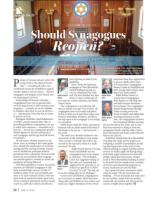
KETER TORAH
The sanctuary at Keter Torah, which began holding
morning services on Memorial Day weekend with
strict guidelines to prevent the spread of COVID-19.
Rabbi Yechiel
Morris
Rabbi Aaron
Starr
Rabbi Robert
Gamer