

D
alia Michaelson, 18,
and her family felt
especially proud of her
graduation from Berkley High
School.
“It’
s a big deal that I graduat-
ed,
” she said. “There was a time
last year where we thought that
I was going to need to be sent
away. We didn’
t think I would
be able to finish junior year.
”
Michaelson refused to go to
school during her junior year.
Most mornings she wouldn’
t get
up. If she did make the drive to
school, she’
d circle the block in
tears. Some days she drove the
loop for an hour. Other days
she’
d drive home after just a few
minutes.
“I felt really overwhelmed by
the expectations that I put on
myself,
” Michaelson said. “It felt
easier to not go than to go and
fail. We thought it was just me
not wanting to get a bad grade,
but it was a lot deeper than
that.
”
Michaelson said she has
always been a perfectionist, and
she began to fear failure when
she started high school. She
often felt scared and anxious
during her freshman and soph-
omore years, but Michaelson
had her first panic attack as a
junior. She also had a difficult
time opening up to family and
friends.
“No one knew what was
going on except for me, and
even I didn’
t completely under-
stand it,
” she added.
One morning, Michaelson
hit her lowest point. While her
mother dropped her brother
off at school, Michaelson sat
on the toilet trying to make
herself throw up to avoid going
to school. She was bawling in
the bathroom when her mother
came back.
“I didn’
t want to keep going
anymore,
” Michaelson said.
“If she didn’
t walk in the door
when she did, I don’
t really
know what would have hap-
pened. That was my turning
point.
”
Michaelson revealed her
thoughts and feelings to her
parents. They acted immediate-
ly. Michaelson saw a therapist
the same day and a psychiatrist
shortly after. She was diagnosed
with anxiety and depression.
With medication and therapy,
Michaelson quickly started
improving.
“
As soon as I started talking
it out with someone, that really
helped,
” she added. “It made me
feel like myself.
”
Michaelson found more sup-
port at school. She reconnected
with her friends and set up a
meeting with her counselor. She
told Michaelson to come direct-
ly to her office whenever she
felt anxious so she would stay in
school.
“I don’
t think people realize
what an ally a school coun-
selor can be,
” Michaelson
said. “Whatever you are going
through they have seen before
and know how to help. I would
not have made it through the
year without mine.
”
Michaelson further improved
when she got involved with
UMatter, a program focused
on empowering teens to shatter
the stigmas surrounding mental
health challenges and suicide.
Michaelson was inspired by her
friend Lauren Schostak when
she shared her experience with
mental illness at the 2019 One
Thing I Wish You Knew event.
“I couldn’
t stop thinking
about how many people in that
room she helped by doing that,
”
Michaelson said. “I realized how
big of an impact it can have.
”
She was inspired to join the
UMatter Teen Board, which
plans events and social media
campaigns.
“The way I felt helping people
through UMatter made me real-
ize that this is what I want to do
in my future career,
” she added.
Michaelson will be attending
the University of Virginia in
the fall to study nursing and
become a psychiatric nurse
practitioner. After refusing to
attend school, Michaelson has
come to appreciate it.
“It was crazy to think about
how bad things were based on
how good things are now,
” she
said. “It helped me reflect and
realize how much I appreciate
school. I will miss it.
”
This is the third in a four-part series
profiling teens who have triumphed
over mental illness challenges.
As soon as I started talking it out
with someone, that really helped.
It made me feel like myself.
— DALIA MICHAELSON
30 | JUNE 11 • 2020
Jews in the D
Overcoming
Fear of Failure
New grad appreciates
how far she’
s come
battling depression
and anxiety.
JENNA ANDERSON CONTRIBUTING WRITER
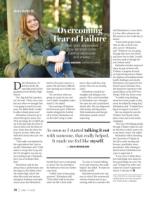
COURTESY OF DALIA MICHAELSON