

86 | MAY 28 • 2020
A
ccording to a
survey from the
Small Business
Administration of Michigan,
one in seven Michigan small
businesses, or 14 percent, are
not confident they will survive
the COVID-19 pandemic.
Those trying to weather the
storm have had to adjust their
business models and do their
best to adapt to a new reality.
Here are how some Metro
Detroit Jewish business own-
ers are changing to succeed
despite the pandemic.
MORTGAGE SECTOR
Bob Rubin is in the mortgage
business at HomeLend USA,
based in Troy. “During the
pandemic, I’
ve been able to do
all of my business from home,”
he said. “I’
ve also decided to
use this time to give back.”
With new technology,
Rubin can help
customers get
their required
paperwork and
signatures, so they
never have to
leave their homes
or let an appraiser
or closing agent inside — per-
fect for maintaining social
distancing.
Rubin decided to turn his
attention to religious orga-
nizations, churches and syn-
agogues. “With rates so low,
this is an ideal time for them
to refinance mortgages and
save several hundred dollars
every month,” he said. “With
most synagogues closed, they
could really use the extra
money now.”
Rubin added that he want-
ed to do something nice for
someone else, as well. “For
new customers, I make a
$1,000 donation to their
favorite charity or religious
organization,” he said.
One customer recently
chose Congregation Beth
Shalom, which received a
check from Rubin.
“Sometimes I don’
t make
any money on the loan at all,
but I feel like I’
m making a
difference,” he said.
STAFFING
Kristi Siegel, founder and
president of Statewide Staffing
in Farmington
Hills, said the
pandemic has
severely impacted
her business due
to the inability to
make wide-scale
hiring decisions
following the shelter-at-home
executive order and social dis-
tancing guidelines.
“
A company like ours bases
its work off of interviewing
candidates and meeting with
new clients,” she said in an
email. “We also interact with
our clients while they utilize
our office for confidential
hiring searches. Through the
shelter-in-place order, this
currently isn’
t being done.
Fortunately for us and those
we represent on both ends of
the hiring process, much of
this process can still be done
virtually.”
Virtual face-to-face meet-
ings have become Statewide
Staffing’
s main source of com-
munication and have allowed
them to get candidates in the
door for positions without the
need for in-person interviews.
As of May 15, it was back
to work as usual for Statewide
Staffing. “We plan to quickly
identify and place top talent in
other industries as the market
begins to adjust,” Siegel said.
“We anticipate it will take
at least a few months, if not
more, for things to normalize.”
RETAIL
Before Michigan Gov.
Gretchen Whitmer’
s stay-at-
home order closed the doors
at Event Bliss in Franklin, the
company had a “decent” social
media presence, according to
owner Terri Trepek. “
After, we
had to go full force — posting
photos and asking clients to
message us or call us if they
wanted to buy something.
Then we would run to the
store, get the item and drop it
off,” she said. “Now customers
can pick up items curbside.”
Early during the stay-at-
home order, before face masks
were necessary for people
going in public places, Event
Bliss decided to offer unique
face masks for customers,
Bob Rubin
Kristi Siegel
JACKIE HEADAPOHL ASSOCIATE EDITOR
Business Not
as Usual
Small business owners adapt to doing
business during a pandemic.
Business
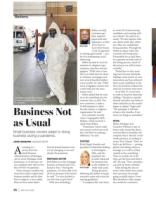
COURTESY OF JAN-PRO
Jared Rothberger has been sanitizing
emergency response vehicles during
the pandemic.