

Arts&Life
books
82 | MAY 28 • 2020
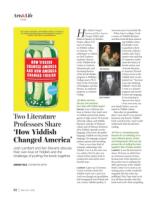
Two Literature
Professors Share
‘How Yiddish
Changed America’
Josh Lambert and Ilan Stavans discuss
their own love of Yiddish and the
challenge of putting the book together.
ANDREW FIELD CONTRIBUTING WRITER
H
ow Yiddish Changed
America and How America
Changed Yiddish, pub-
lished in January by Restless
Books, collects 150
years of writing
on Yiddish culture
in America. The
anthology’
s co-editors
are Josh Lambert,
academic director
of the Yiddish Book
Center in Amherst,
Massachusetts, and
incoming director
of the Jewish Studies
program at Wellesley
College (and a Ph.D.
alum of the University
of Michigan), and Ilan
Stavans, an endowed
professor at Amherst
College.
JN: Where and how
did your own personal
love affair with Yiddish begin?
Stavans: I am a Mexican Jew,
born in Mexico City, [and] went
to Yiddish school from kinder-
garten to high school. We learned
of Jewish culture, and Yiddish
literature, and also of Mexican
culture and of Mexican literature,
all in Yiddish. Spanish was the
language of the street, the public
language; Yiddish was the private
language, the language of grand-
parents, parents and schooling.
I have a very close, kind of
romantic relationship with
Yiddish. I see it as the entry way
to a culture. But I’
m also very
critical of that culture, both in
constructive and maybe more
forceful ways.
Lambert: I grew up in Toronto;
I went to Jewish school, but
Yiddish wasn’
t ever a part of it.
And even though my grandfather
had immigrated from Poland and
was a native Yiddish speaker, it
was never part of my family life.
When I got to college, I took
a course on Yiddish literature
and discovered all these interest-
ing Yiddish writers.
Eventually I went
to graduate school
to become a literary
scholar, and I had a
mentor who said that
if I wanted to under-
stand the history of
Jewish writers, and
of Jewish literature
in America, I’
d need
to have access to the
Yiddish texts. So she
pushed me: “You have
to go start studying
Yiddish!” And I did.
I went to a summer
program and started
to learn the language.
It was amazing to
discover how much
of my own story, my
own family history, was con-
tained in Yiddish culture.
Years after my grandfather
died, I went down to my parents’
basement and found a Yiddish
book owned by him. And I could
understand what he had been
reading.
JN: This is a fascinating book
because it’
s an anthology of so
many different genres, writers
and backgrounds. What was the
process like of putting the book
together? Was it totally chaotic?
Lambert: It was the best kind of
chaos. We knew we didn’
t have
an enormous amount of time,
because part of the intention of
this project was to celebrate the
40th anniversary of the Yiddish
Book Center. So we used as our
starting point a really wonderful
magazine that the center has
published. Pakn Treger tried to do
over all those decades what this
book tried to do: Find compelling
Ilan Stavans
MERYL SCHENKER PHOTOGRAPHY
Josh Lambert
UMASS.EDU