

78 | MAY 28 • 2020
A
s University of
Michigan students,
we have experienced
many stressors driven by the
pandemic, including the adjust-
ment to online school, cancel-
lation of milestones and loss of
various experiences.
I, Sarah Wish, a rising
University of Michigan senior
from New Jersey, was abrupt-
ly sent home from my study
abroad program in Denmark.
I, Marissa Levey, a recent
University of Michigan grad-
uate, lost my last two months
of senior year, including my
graduation.
Through our own research
and conversations with
students, we realized that
students everywhere were
struggling. With no central-
ized resource to specifically
support students, students did
not have a way to navigate
the constant influx of news
and spread of misinformation
during this time.
We decided to create an
Instagram account, sponsored
by the Mount Sinai Health
System, dedicated to supporting
students during the pandemic.
The Instagram, @covid-
19studentsupport, is a platform
committed to supporting stu-
dents, by students, during the
pandemic. Even though we are
U-M students from New Jersey,
our content is geared to support
all students of all backgrounds
from all campuses during these
hard times.
We aim to share scientific
evidence-based COVID-19
information, to support student
mental and physical well-being,
and to address common student
questions and concerns about
the virus.
We hope this account gives
students a way to navigate this
trying and unprecedented time,
by acknowledging the challeng-
es our peers are facing and pro-
moting ways to cope with these
difficulties.
We aim to specifically
address the unique stressors
Online Support
Two Jewish U-M students start Instagram
account dedicated to supporting students
during the COVID-19 crisis.
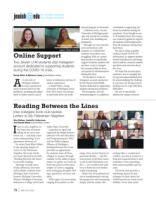
Sarah Wish & Marissa Levey } jewish@edu writers
Sarah Wish & Marissa Levey
started an Instagram account to
support college students.
COURTESY OF U-M HILLEL
for college students
by college students
Reading Between the Lines
Inter-collegiate book club tackles
Letters to My Palestinian Neighbor.
I
turn to you, neighbor, in
the hope that an honest
telling of my story may
touch you — and help create
some understanding, if not
agreement, between us.”
So writes Yossi Klein Halevi
in the opening chapter of
Letters to My Palestinian
Neighbor, the book which
our Israel-themed book club,
“Reading Between the Lines,”
is currently reading.
Meeting virtually every
Friday afternoon, the book
club includes students from
Michigan State University,
Eastern Michigan University,
Western Michigan University,
Kalamazoo College and Grand
Valley State University.
Launched in April and
organized by Maddi Jackson
(director of Israel Education
and Programming for MSU
and the Hillel Campus
Alliance of Michigan),
Reading Between the Lines
provides an opportunity
for students from all these
colleges to connect through
reading. In the midst of quar-
antine, we gather on Zoom for
lively discussion of the latest
chapter of Letters, engaging
and exchanging thoughts, feel-
ings, questions, concerns and
ideas.
With topics of conversation
ranging from politics to the-
ology, from ancient history to
personal identity — and the
intersection of all these issues
in the Israeli-Palestinian con-
flict — our weekly book club
hour is both fun and intellec-
tually stimulating.
Halevi has the profound tal-
ent of simultaneously voicing
his perspective and resonating
deeply with his reader. His
writing takes a complicated
conflict, one that is rooted in a
long and nuanced history, and
translates it into something
both understandable and inti-
mate.
The book club provides a
refreshing chance for par-
ticipants to think about the
world beyond our usual social
bubbles. Seven time zones
Noa Dahan, Isabella Lieberman
and Sarah Weiss } jewish@edu writers