

MAY 28 • 2020 | 23
JN: What is the status
of affiliation talks with the
Henry Ford Health System?
Dr. Schweitzer: We are
having clinical affiliation
talks with a number of insti-
tutions. No one institute can
take the whole class. We need
capacity to handle unexpect-
ed situations.
JN: Were you concerned
about taking this position
given the turmoil among the
members of the University
Board and the opposition of
some toward Dr. Wilson?
Dr. Schweitzer: I met with
every member of the board;
they initiated it. There was a
unanimous vote to support
my hiring. I expect a produc-
tive relationship. They asked
about the (medical school)
tuition increase but that was
appropriate.
JN: Will the COVID-19
have any impact on medical
school curricula?
Dr. Schweitzer: How far
does a rubber band stretch?
There is inertia. When you
let go, does it stretch or
break?
JN: What about hospitals?
Will they be better prepared
for the next emergency?
Dr. Schweitzer: For the
next decade, yes. After that,
no.
JN: What was your impres-
sion of the Canadian health
care system?
Dr. Schweitzer: We have
some really excellent health
care (in the U.S.) but in
Canada, at least each prov-
ince has a system that can
manage within its system
effectively. Canada has a
more holistic training sys-
tem, which I want to instill
here. There is a focus on the
broader societal impact —
not just treating one patient
but all patients with the judi-
cious use of resources.
Filling
the Gap
Project Healthy
Community expands
distribution efforts in
Northwest Detroit.
P
roject Healthy
Community (PHC), a
nonprofit organization
focused on aiding community
wellness and education efforts
in Northwest Detroit, is expand-
ing food and hygiene product
distribution to families and
senior citizens in response to
the COVID-19 pandemic.
Over the next three months,
the organization aims to raise
$250,000 for its COVID relief
efforts, according to a letter
from PHC’
s president and CEO
Dr. Melvyn Rubenfire.
Karen Rubenfire,
PHC’
s COO and
Melvyn Rubenfire’
s daughter,
told the Jewish News that the
group has already raised
$141,782, thanks to grants,
major donations and smaller
individual gifts.
PHC plans to allocate around
$72,000 to purchasing sup-
plies for a home and personal
hygiene pantry made available
to families in Northwest Detroit.
“People don’
t just need
food in order to be healthy,
”
Karen Rubenfire said. “You need
to have cleaning products for
your home, hygiene products
for yourself, things like that.
”
$40,000 will go toward an
“SOS” fund PHC has set up
in coordination with four of
its partner schools to help
Northwest Detroit families over
at least the next four months.
Families can apply for SOS
stipends monthly, and PHC
has already received about
22 applications for funds,
Karen Rubenfire said.
“The goal is to extend this
beyond four months,
” she
said. “It’
s not going away quick-
ly, and there’
s such urgency.
”
PHC also intends to devote
$138,000 of its target amount to
providing food to seniors and
families in Northwest Detroit
who aren’
t currently covered by
the organization. PHC partners
with Gleaners Community
Food Bank and Forgotten
Harvest to run a food pantry in
the area and has worked with
Gleaners to expand its reach
since the pandemic started.
The organization is also
working to maintain and
expand its Family Wellness
Center and in-home health
behavior courses, which aim to
address disparities in preventa-
tive care in the community.
PHC was inspired by
Temple Israel’
s Rabbi Joshua
Bennett in 2012, when he
gave a Yom Kippur sermon
about the importance of com-
munity service work. Shortly
after, Melvyn Rubenfire, a
Temple Israel member, estab-
lished the nonprofit, along with
his late wife, Diane, and their
daughter Karen. Many of PHC’
s
programs are run out of the
Northwest Activities Center,
a former Jewish Community
Center in Northwest Detroit.
When COVID-19 came
to Michigan in March,
the Rubenfires and their
colleagues at PHC knew they
wanted to help the community
where they’
ve been working for
the past eight years.
“When this all first started …
we knew we had to do some-
thing quickly that would be as
impactful as the rest of the stuff
we do,
” Karen Rubenfire said.
“The focus was around
emergent needs and this
addition to making our food
pantry much more sustainable
and impactful for the families.
”
Detroit residents have been
hit hard by the COVID-19
pandemic. With high rates
of poverty and poor access
to healthcare, Detroit’
s
communities of color have
found themselves particularly
vulnerable to the virus.
PHC has worked with com-
munity members in northwest
Detroit to identify what resi-
dents need during these chal-
lenging times.
“We’
ve tailored all of our pro-
grams around the community’
s
ask, so to speak, filling those
gaps.
“This was another opportu-
nity,
” she said. “We wanted to
be that vehicle to provide those
resources.
”
MAYA GOLDMAN
CONTRIBUTING WRITER
KAREN RUBENFIRE
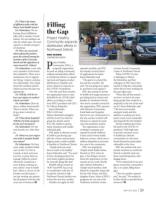
Northwest Detroit residents pick
up supplies from a Project Healthy
Community food pantry.