

MAY 28 • 2020 | 19
Dealing with Dyslexia
Local teen shares his journey to overcome
learning challenges.
A
lex Bean was only 13
years old when he
heard his English teach-
er say, “I really don’
t believe in
Alex. I don’
t think he has the
ability to go anywhere in life.
”
She unknowingly revealed this
to Bean while on speaker phone
with his English tutor.
She called Bean later that day
to apologize, but he wouldn’
t
accept it.
“I will use this every day to
prove you wrong,
” Bean told
her.
Now Bean, 17, has graduated
from Frankel Jewish Academy
with a 3.7 GPA and will be
attending Indiana University to
study media, technology and
culture with a minor in fashion
design.
Bean was diagnosed with
dyslexia in fourth grade.
Throughout elementary and
middle school, he was given
excessive help.
“
A lot of things were handed
to me. I never had to put much
effort into anything,
” he said.
“It became a curse. This only
put me at a lower advantage for
high school.
”
When he started high school
at FJA, everything changed. He
was put into difficult classes and
no longer had a hand to hold.
Bean, who describes himself as
an “anxious person,
” became
extremely overweight due to his
stress. He leaned on therapy for
his mental health, but this didn’
t
solve his other problems.
“They put me into a mas-
sive ocean,
” he added. “I was
always the kid who would say,
‘
Everything is everyone else’
s
fault but mine.
’
They thought I
was just a kid that didn’
t care.
There were a lot of teachers
who gave up on me.
”
Bean encountered an espe-
cially difficult teacher his soph-
omore year. After continuing to
fail in his class, Bean scheduled
a meeting with the teacher, but
it solved nothing. Bean said
this teacher even called him an
“idiot” and a “terrorist.
”
Bean went to his parents,
hoping they would fix the sit-
uation like usual. But this time
was different. Seth Korelitz,
director of Jewish studies at
FJA, called Bean into his office.
“He told me going through
life will only become a disaster
if you rely on other people to
take care of the issues for you,
”
Bean said. “It really made me
think.
”
Shortly after this experience,
Bean was in a clothing store
with his father. He noticed that
while he tried on a size XXL
hoodie, his father was wearing a
men’
s medium.
“It all hit me,
” Bean said. “I
realized that I need to become
my own person.
”
Bean started volunteering at
Friendship Circle and getting
involved with UMatter, a pro-
gram focused on empowering
teens to shatter the stigmas
surrounding mental health
challenges and suicide.
“I became very immersed in
that world,
” he said. “It taught
me how to advocate for myself
and be my own independent
person.
”
Bean also used music, writ-
ing and tennis to cope with his
stress and anxiety.
“It was the first time in my
day where I didn’
t have to think
about anything except hitting a
ball,
” he added.
Bean’
s biggest inspiration is
his aunt, Lindsey Finsilver, who
passed away from cancer in
2016. Whenever he feels frus-
trated or unhappy, he thinks of
his aunt for motivation.
“If she can fight, I can fight,
”
Bean said.
While Bean’
s mental state was
improving, so was his physical
state. He lost nearly 50 pounds
with the help of a teacher,
Adam Shireman, who is also a
bodybuilder. They shared goals
and developed a friendship.
Bean’
s weight loss boosted his
confidence in every aspect of
his life.
“One day I woke up and I
was dealing with everything on
my own,
” he said. “I’
ve become
very happy with who I am. I
accept every single one of my
flaws.
”
This is first in a series about teens
overcoming their mental health chal-
lenges.
JENNA ANDERSON CONTRIBUTING WRITER
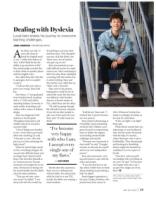
COURTESY OF ALEX BEAN
“I’ve become
very happy
with who I am.
I accept every
single one of
my fl
aws.”
— ALEX BEAN