

MAY 28 • 2020 | 15
A Whole New World:
Virtual Learning
During a Pandemic
Teachers face new challenges trying to educate
their students from a distance.
CORRIE COLF STAFF WRITER
Jews in the D
B
efore the coronavirus
pandemic, classrooms
were filled with students
and teachers, hallways were a
place to see friends and catch
up on the latest gossip, and
gyms were filled with athletes
and families cheering them on.
Now, everything has moved
online, and classrooms are
now in kitchens, bedrooms
and office spaces in students’
homes.
Technology glitches are
inevitable and are now com-
mon occurrences for some
classes. Amy Stein, a Jewish
studies teacher at Farber
Hebrew Day School, was
bringing her students back
from a Zoom breakout group
session when everyone’
s videos
had frozen. Luckily, the sound
was still there. Stein continued
with the lesson and slowly, one
by one, each student’
s video
began to come back.
Teachers have also had to
encourage engagement from
students through discussions
by calling on them individ-
ually to discuss homework
assignments or in-class exer-
cises. Stein, for example, has
her students mute themselves
and use the chat box function
on Zoom so no one begins to
talk over one another. Talking
over one another is hard
enough in the classroom, but
in a virtual setting, the result
is deafening silence due to
Zoom’
s settings automatically
muting crosstalk.
It has now been over two
months since Gov. Gretchen
Whitmer closed schools
throughout Michigan due to
COVID-19. On April 2, dis-
tricts were tasked with devel-
oping individualized plans for
their teachers and students to
engage in distance learning.
Many students, especially
seniors, are still struggling
with the notion of not being in
the classroom and celebrating
the end of their high school
careers with proms and grad-
uation.
Zoom classrooms, Google
Hangouts and recorded lesson
plans have become the new
“norm” for students and teach-
ers. Sitting at home, staring
at a screen all day is difficult
and strange, but still allows
for students to feel a sense of
togetherness while being apart
from one another.
However, teachers from
local schools around Oakland
County have risen to the
challenge and are trying to
overcome obstacles to engage
with their students as much
as they can through this new
virtual age.
FRANKEL JEWISH ACADEMY
At Frankel Jewish Academy in
West Bloomfield, teachers have
been using Google Hangouts
to engage with their students.
Rebecca Strobehn, a ninth
grade Jewish studies teacher,
has been a teacher at FJA for
three years. Although she is
proud of her students’
resil-
ience, nothing can compare
to seeing her students face-to-
face on a daily basis.
“The part of teaching I love
most is the daily interactions
with my students, both formal
and informal. In our current
online learning structure, we
have limited face-to-face time
with our students and such
limited opportunities for just
being together without the
pressures of a lesson plan,”
Strobehn said. “Even as some-
one who has grown up in the
digital age, I have always pro-
cessed in-person interactions
differently from digital ones.
It’
s just not the same seeing
and talking to my students on
a screen.”
Strobehn has also changed
her approach to teaching
during this time. She tries to
make time during each lesson
to check in with her students
and find out how they’
re doing
outside of academics. In a few
of her classes, she has struc-
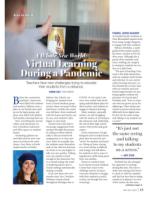
Amy Stein
“It’s just not
the same seeing
and talking
to my students
on a screen.”
— AMY STEIN
continued on page 16