

MAY 14 • 2020 | 25
COVID-19 infection, the National
Convalescent Plasma Project has launched a
website for health care providers, patients
who have recovered from COVID-19 infection
and want to donate plasma, and those
considering the treatment.
Last month, the Food and Drug
Administration expedited the compassionate
use of convalescent plasma for care of
seriously ill patients infected with coronavirus
that causes COVID-19 disease. The use of
convalescent serum involves taking the
antibodies of those who have recovered and
giving them to someone else who is fighting
the virus.
Epidemiologist
Nigel Paneth, an
MSU professor
and member of
the project’
s
leadership team,
along with
colleagues from Johns
Hopkins University and the Mayo Clinic, led
the development of the National
Convalescent Plasma Project. The project
includes 170 physician-scientists from 50
universities and hospitals across the nation
studying the use of convalescent plasma in
COVID-19 treatment and prevention.
MSU epidemiologist
part of national team
pursuing COVID-19
treatment
Finding a treatment for COVID-19 is urgent,
and a new effort coordinated by an MSU
epidemiologist and colleagues around the
country aims to use convalescent plasma,
which is plasma from recovered patients,
to treat the infection.
As part of the next step to advance the use
of convalescent plasma for the treatment of
Continued on page 4
While Michigan State University’
s
response to the COVID-19 pandemic
has required students to adjust to
virtual classes and extracurricular
activities, MSU Hillel also has created
virtual programming so students can
remain connected to Hillel staff and to
one another.
MSU Hillel Associate Director Robyn
Hughey has led the transition to
online programming.
“Upon learning about the seriousness of
the pandemic, our staff quickly worked
to create a number of innovative online
experiences and gatherings to help
students across the state stay connected
to Jewish life while at home,” says
Hughey. “Since the creation of our online
calendar in mid-March, we have pivoted
some programming based on interest,
but our dedication to supporting
students has remained strong and is at
the core of all that we are doing.”
Hughey and her team’
s quick pivot
helped students feel tuned in to
everything the organization offers.
Programs include online Jewish learning,
making Jewish baked goods, engaging in
mindful meditation, maintaining physical
and mental well-being, and more.
“In addition to these programs, our staff has
been working hard on personal outreach
to students, and we have been scheduling
virtual coffee dates,” says Hughey.
As far as formats go, Hughey and her
colleagues have been using Zoom,
Instagram’
s IGTV, Instagram Live and
Facebook Live to reach students around
Michigan and across the country.
“Staff members are still available for phone
and Zoom calls during regular hours so they
could be there for students,” says Julia Levy, a
junior and former executive member of the
Jewish Student Union. Levy also mentions
that to try to make things interesting, staff
members have gone on MSU Hillel’
s
Instagram account to talk about their time
in quarantine.
Another way students are staying
connected to one another and to their faith
is through a virtual book club, which is
reading “Letters to My Palestinian Neighbor”
by Yossi Klein Halevi.
“The book club has allowed me to connect
not only with MSU students, but also with
students from different schools and
campuses across Michigan,” says Cooper
Myers, a junior and former vice president of
community programming at MSU Hillel.
“These new connections bring new thoughts,
ideas and perspectives that I did not have
prior to reading the book.”
MSU Hillel’
s goal is to maintain a sense of
community during difficult times. The
organization also hosted a virtual Passover
Seder via Zoom. While the shift to virtual
settings during the pandemic has temporarily
disrupted daily life, MSU Hillel will continue to
help students feel they have a home away
from home and a connection to MSU. e
MSU Hillel creates virtual programming to support students
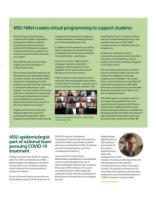
Students participate via Zoom in MSU Hillel’s
virtual book club.