

6 | MAY 7 • 2020
Views
essay
The Faces of the Dead
O
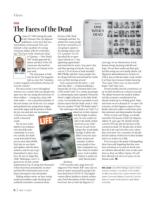
n June 27, 1969, during the peak
of the Vietnam War, Life Magazine
published a cover story that was
immediately controversial. The cover
featured a close-up photo of a young
American soldier, with the words blaz-
ing “The Faces of the Americans Dead
in Vietnam — One Week’
s
Toll.
” Inside appeared the
names and faces of the 242
Americans who had lost
their lives in Vietnam in the
past week.
“We must pause to look
into the faces,
” the magazine
told us, since this “translates
to direct anguish in hundreds of homes all
over the country.
”
The story struck a nerve throughout
America. In a country that was already torn
apart over the war, seeing the fresh faces of
those soldiers — young men, many with
wide smiles — was a powerful reminder of
the true human cost of the war. In a unique
and profound way, seeing those images
stirred the anger and the passion of both
the pro-war and anti-war movements.
A picture was, indeed,
worth a thousand
words.
We are now in the
depths of an insidious
virus that kills indis-
criminately. In a mere
two months, the death
count skyrocketed from
zero to more than 40,000.
Each day we see charts
and updates with the latest
statistics, and it’
s easy to get
desensitized to these num-
bers. It’
s easy to forget that
while “flattening a curve” is
good news, it’
s just a sterile
mathematical way of saying that thousands
of lives have been prematurely cut short
and there’
ll be thousands more in the
future, leaving love ones devastated.
Making matters worse, we hear certain
media personalities make shocking and
recklessly insensitive comments about
the loss of life. Rush
Limbaugh said that “no
matter how many people
die from coronavirus, it’
s
not going to equate to
the damage done to the
U.S. economy.
” Dr. Oz
described the re-open-
ing of schools as a “very
appetizing opportunity”
and noted that he read a “nice piece” that
said that opening of schools “may only
cost us 2-3% in terms of total mortality.
”
Bill O’
Reilly said that “many people who
are dying, both here and around the world,
were on their last legs anyway.
”
Each comment has the intent — and
often the effect — of depersonalizing a
human life. Dr. Oz’
s comments that a loss
of life would “only” be a certain percentage
is, unfortunately, often repeated. Whenever
there’
s a slight reduction in the daily death
count, we inevitably hear journalists or pol-
iticians report that the death count is “only”
the new number (“Only 700 deaths today”).
But referring to the dead as an “only” is a
disservice to their memory
and the height of callous-
ness. No one would ever
refer to the death of their
loved one as an “only.
”
The use of such termi-
nology does incalculable
damage. It allows the
fallen to become inan-
imate, faceless and
nameless. It allows
some people to lose
their compassion at a
time when it’
s needed
most. And it enables
leaders to make seri-
ously flawed policy
decisions.
CNN recently took a page from Life
Magazine’
s “One Week’
s Toll” story and cre-
ated an online memorial for people who
have died from COVID-19. This digital
version allows families to submit a photo
and a brief description of their deceased
loved one. Just as with Life Magazine 51
years ago, we see vibrant faces of real
human beings, beaming with life and
hope. We see their smiles and their grit,
just like seeing our own family photos. Life
Magazine’
s admonishment to America in
1969 is just as relevant today: Look careful-
ly at those faces because besides knowing
“how many” there were, we also mustn’
t
forget “who” they were.
Several months into this coronavirus cri-
sis we find ourselves at a critical crossroad.
The debate between the medical realities
and the economic considerations has
already heated up to a boiling point. More
and more we see a demand to “re-open” the
economy. As that happens, expect to hear
louder and more callous words from some
that minimize and depersonalize the dead.
When we hear such things, we should
remember the lessons of that Life Magazine
edition 51 years ago. We should visit the
current CNN site and see the faces of the
coronavirus dead. We should stare at those
faces for a bit, read who they were, where
they were from. For a moment, we should
feel the sadness of their loss to their families
and to us, maybe cry a little.
If we ever get to the point of disregarding
those faces and forgetting that they were
once as human as we and our loved ones,
we will have allowed this virus to take more
from us than our fellow citizens. We will
have allowed to it rob us of a piece of our
human souls.
Mark Jacobs is the AIPAC Michigan chair for African
American Outreach, a co-director of the Coalition
for Black and Jewish Unity, a board member of the
Jewish Community Relations Council-AJC and the
director of Jewish Family Service’
s Legal Referral
Committee.
Mark Jacobs