

28 | MAY 7 • 2020
Arts&Life
books
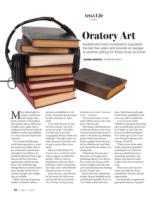
Oratory Art
Audiobooks have increased in popularity
the last few years and provide an escape
to another setting for those stuck at home.
SUZANNE CHESSLER CONTRIBUTING WRITER
M
issy Selfon began lis-
tening to audiobooks
while coping with a
family member’
s serious illness.
She needed a literary distraction
available more readily than in
traditional book format while she
fulfilled everyday responsibilities
as a wife, mom and employment
counselor.
Now retired and following
social distancing advice to avoid
the coronavirus, Selfon still val-
ues audiobooks as distractions.
Through her local library, she
installed audiobook iPhone apps
that provide free borrowing
opportunities without leaving
home. Free audiobook apps
through libraries include cloudLi-
brary, Hoopla and OverDrive.
Commercial apps, like Audible,
also are available.
Selfon is among the growing
number of listeners, authors,
narrators and publishers in the
Jewish community giving reasons
for their attractions to audio-
books.
“I not only look out for what
the book is about, I also look
out for the reader,
” said Selfon
of White Lake, active with
Congregation Shaarey Zedek and
Hadassah. “The right reader can
make characters come alive, and
it’
s easy to picture them in my
mind.
”
Selfon recently finished The
Wartime Sisters, a novel by Lynda
Cohen Loigman, and liked the
narrator. When it comes to
biographical works, she enjoys
listening to writers reciting their
own texts, such as with Michelle
Obama’
s memoir, Becoming.
Sarah Hurwitz, a speechwriter
for the former first lady, wrote
and narrated her own memoir,
Here All Along: Finding Meaning,
Spirituality and a Deeper Connection
to Life — in Judaism.
“Because this book is so inti-
mate, I didn’
t want an actor read-
ing it,
” Hurwitz said.
Altie Karper, editorial director
at Schocken Books in New York,
welcomes the growing interest in
audio as she heads up publishing
projects with Jewish themes.
Karper explains that books writ-
ten by celebrities are more likely
to be narrated by the authors as a
selling point.
“
Audiobooks have become a
phenomenon throughout the
publishing industry over the last
four or five years because of the
advent of digital audio files that
can be downloaded onto listening
devices,
” Karper said.
Recent Schocken audiobooks
include Aharon Appelfeld novels
and Deborah Lipstadt’
s History on
Trial, which is about anti-Sem-
itism. Newly discovered books
by Eli Wiesel, unpublished until
now, soon will be audiobooks.
A survey by the Audio
Publishers Association found that
sales of audiobooks reached near-
ly $1 billion in 2018. Fifty-five
percent of audiobook listeners
were under age 45, and 51 per-
cent of frequent listeners were
between 18 and 44.
“What we love about audio-
books is that they expand the
readership for our books the
same way ebooks have been
expanding readership,
” said
Karper, who listens to audio-
books on the train to and from
work.
What actors and voiceover
artists especially love about
audiobooks is that they add job
opportunities.
Eva Kaminsky, recognized for
guest performances on popular