

36 | APRIL 30 • 2020
“That really resonated with
them.
”
They enjoyed Israeli cinema,
too. Yet the festival he came to
coordinate was often the only
nearby spot they could find
Israeli works.
“We weren’
t renting it —
VOD didn’
t exist then. And it
wasn’
t at Blockbuster, so there
was like one week a year you
would see these things,
” he
said. “
And that became a really
big event.
”
After coordinating the
WJFF, Gardner served as an
associate programmer and,
eventually, PR and marketing
manager at the American Film
Institute’
s AFI Silver Theatre,
a restored Art Deco space in
Silver Spring, Maryland, that
he compares to Ann Arbor’
s
Michigan Theatre. Over six
years there, he programmed
Latin American, Caribbean
and New African-focused
festivals — working, as at the
Film Lab, to expose viewers to
works and cultural experiences
they might not discover on
their own.
“Doing these deep dives
into cinemas from other places
around the world really got
me interested in engaging
local communities,
” he said. “It
was a fulfilling experience for
us (as programmers) and for
them (as viewers) to be able to
see themselves represented on
screen.
”
When Gardner’
s wife, Maya
Barak, was offered an academ-
ic position at the University
of Michigan-Dearborn in
2016, they relocated to Metro
Detroit. Not long after, he
founded the nonprofit Cinema
Lamont, which organized fes-
tivals and world cinema pop-
up events around the area. The
entity’
s stated mission: “To
foster cross-cultural under-
standing through the power of
world cinema.
”
Spaces like Hamtramck’
s
Oloman Cafe, Eastern Market’
s
Trinosophes café and the
restored Schvitz bathhouse in
Detroit’
s North End all played
host to thoughtfully curated
screenings, as did more tradi-
tional theaters like the Senate
Theater and Cinema Detroit.
The Schvitz, for instance,
played the 2007 mob film
Eastern Promises, notorious
for a lengthy bathhouse fight
scene; Southwest Detroit’
s
Pizzaplex showed low-budget
spaghetti Westerns.
A FILMSTRIP PARTNERSHIP
In 2017, Cinema Lamont
won a grant from the Knight
Foundation for Cine Mexico
Now, a film festival first host-
ed at Cinema Detroit. At the
continued on page 38
Virtual Cinema:
Supporting
Theaters from
Home
During the COVID-19 outbreak,
all movie theaters have closed
their doors. So the Film Lab has
pivoted to a “virtual cinema.”
A slate of current arthouse
releases are available for rental
as video-on-demand (VOD) pro-
gramming options via the the-
ater’
s website, thefilmlab.org.
The option is available thanks
to the theater’
s partnerships
with indie distribution compa-
nies like Kino Lorber and Film
Movement, who are offering the
films as VOD rentals in order to
support independent cinemas
across the country during mass
theater shutdowns.
Several other local theaters,
including the Detroit Film
Theatre, Cinema Detroit, the
Emagine multiplex chain and
the Michigan and State Theatres
in Ann Arbor, are also offering
virtual cinema options.
“It’
s been really fun to be
able to offer a wider variety of
programming than we normally
do because we’
re no longer hin-
dered by physical constraints,”
Gardner said, noting that a vir-
tual cinema could have potential
even after the Film Lab reopens.
“Obviously, the in-person
theatrical experience is the
primary way to do things, but
perhaps with some of these
smaller films and smaller dis-
tributors, they’
d be open to an
online virtual cinema to continue
(their) run for additional weeks,
or even potentially films that we
didn’
t have the time to run.”
Prices and rental periods vary,
but most films are $10-$12.
Check your favorite theater’
s
website for more details.
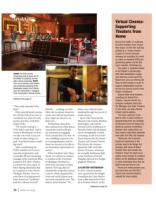
ABOVE: The Film Lab has
temporarily shut its doors due to
the COVID-19 outbreak, but still
offers virtual screenings. RIGHT:
Film Lab co-founder Josh Gardner,
who previously programmed the
Washington Jewish Film Festival,
says he’
s interested in “engaging
local communities” through movies.
Arts&Life
continued from page 35