

46 | APRIL 16 • 2020
Looking Back
From the William Davidson Digital Archive of Jewish Detroit History
accessible at www.djnfoundation.org
A Look Back at a
Homegrown Fascist
Y
ou may have been watching The Plot
Against America on HBO and reading
JN Editor Andrew Lapin’
s columns
about the series online. Plot is based upon
a fictional situation — thank God — where
fascism has become the ruling political force
in America. There is a dem-
agogue in the White House,
Charles Lindbergh, and the idea
that such an occurrence “could
never happen here” is turned on
its head. The fictional phenom-
enon unfolds through the lens
of the Levins, a middle-class
Jewish family. (See page 28 for
more.)
There are many nuances to the Plot’
s char-
acters and storyline. Lapin is providing JN
readers with a weekly review and is dealing
with serious historical issues: in particu-
lar, the role of Jews and their assimilation
into American society. In today’
s climate
of rising anti-Semitism and intolerance, we
should give these issues proper consider-
ation because, in the real America of the
1930s and 1940s, we did indeed have several
homegrown fascists and Hitler admirers. And
Charles Lindbergh was among them.
“Lucky Lindy” gained global recognition
in 1927 at age 25, as the first person to make
a solo, non-stop, trans-Atlantic flight from
New York to Paris. It was a courageous act
and a transformational moment that forged
the way for commercial aviation. Lindbergh
became an instant American hero, receiving
the Medal of Honor.
In 1940, Lindbergh would once again earn
national notoriety for another reason. He
was a leader of the America First Committee
(AFC). On paper, the organizing principle
of the AFC was isolationism; that is, opposi-
tion to America entering WWII. The name
seems benign. What citizen would not put his
or her nation first? But the AFC had a very
dark side. Underlying the AFC was a vein of
anti-Semitism, racial bigotry and intolerance,
along with some admiration for Hitler’
s pol-
itics.
Lindbergh gave a speech on Sept. 11, 1941,
illustrating this point. He suggested that,
along with President Franklin D. Roosevelt,
American Jews were pushing the U.S. to
enter WWII, and that this was against
the nation’
s best interest: “Instead
of agitating for war, the Jewish
groups in this country should be
opposing it in every possible way,
for they will be among the first
to feel its consequences … A few
far-sighted Jewish people realize this
and stand opposed to intervention.”
He elaborated: “Their [Jews’
] great-
est danger to this country lies in their
large ownership and influence in our
motion pictures, our press, our radio
and our government.”
Claiming that he was not against
Jews — don’
t anti-Semites always
say this? — Lindbergh claimed that
Jewish leaders, “for reasons which
are not American, wish to involve
us in the war.”
Although Lindbergh had made
anti-Semitic statements before,
this speech created a furor in the
American Jewish press, includ-
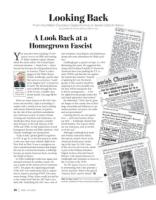
ing in the Sept. 26, 1941, issue
of the Detroit Jewish Chronicle, which
is part of the William Davidson
Digital Archive of Jewish Detroit
History. I also found references to
Lindbergh’
s anti-Semitism in issues of
the JN as late as the 1970s.
The Plot Against America is certain-
ly entertaining, but it also presents a
serious question. What is the goal of
“
America First” and for whom?
Want to learn more? Go to the DJN Foundation
archives, available for free at www.djnfoundation.org.
Mike Smith
Alene and
Graham Landau
Archivist Chair
y
ance,
pol-
941,
elt
Rooseve
U.S. to
inst
is
.”
eat-
eir
elt,
ou
d
st
at
h
ur
io
t
t
f
tion
on.org.