

18 | APRIL 9 • 2020
I
n response to medical
supplies running low due
to the rapid spread of the
coronavirus, staff at Frankel
Jewish Academy (FJA) began
using their STEM lab’
s 3D
printers to create protective
face shields for the medical
community.
Since March 27, FJA
Director of Innovation and
Technology Dan Bourdeau
and STEM Lab Manager
Dale Rogers have created 40
shields, while enabling con-
tactless pick-ups for nurses
and doctors stationed at
mobile COVID-19 testing
sites in Farmington Hills.
The project took off after
Nicole Kahn, a teacher at
FJA, inquired if the school’
s
STEM lab had the capacity to
produce personal protective
equipment.
“Nicole’
s brother is in the
medical profession over
on the East Coast and was
relaying messages to her
about how desperate the sit-
uation was for medical staff
to receive more supplies,”
Bourdeau said. “That got the
ball rolling for us to start
looking at ideas to help our
own community. With about
an hour of research, I was
able to find a design that met
the material capability that
we have here in the lab.”
According to Bourdeau,
there is an abundance of
designs of protective face
shields that can be 3D printed
or produced locally, but there
are also a number of designs
that aren’
t ideal for hygienic
reasons.
Bourdeau and Rogers are
producing a design involving
all non-porous plastic, which
makes it easy to wipe down
and does not absorb any sub-
stances. The product is also
lightweight and cost-effective
to make with products readily
available in their lab.
While there are multiple
types of 3D printers, the FJA
STEM lab printer uses a plas-
tic filament that is heated,
and then squeezes out small,
thin layers of molten plastic,
which harden on top of one
another. The printer forms
the product layer by layer,
and then cools to form the
final product.
“We are constantly optimiz-
ing our printing process so we
can use less material and print
them faster,” Bourdeau said.
“We started with printing two
pieces at a time, and now we
are up to three pieces. We are
also creating these pieces at
less than 45 minutes per piece
instead of 90 minutes per
piece when we first started.”
With the school being
closed, Bourdeau or Rogers
have to go in by themselves,
remove the parts from the
machine and start the next
round.
They are now exploring
options to move the machine
so they can easily access it to
enable the printer to run any-
where from 10-24 hours a day
to ramp up production.
“We are hyperlocal, and we
are filling the need for this
equipment within our own
communities,” Bourdeau said.
“We are helping our neigh-
bors who are doing mobile
COVID-19 testing because it
is these local doctors who are
on the low end of receiving
more assistance from the state
or federal government.”
Bourdeau and Rogers are
now working off a list of
requests from the community
for their face shields. As of
today, they have requests for
more than 100 face shields.
“We have no plans on stop-
ping production — we actual-
ly just received some donated
parts to continue making
these shields,” Bourdeau said.
“We will not stop until the
need is not there anymore.
This whole process has been
gratifying to be able to help
in some very small way.”
If you or someone you know would
like a face shield, you can email
info@frankelja.org with your name,
how many shields you want, where
the shields will be used and contact
information to arrange pickup. You
can also donate to help FJA contin-
ue to buy the materials needed to
produce the face shields by going to
frankelja.org/donate.
CORRIE COLF STAFF WRITER
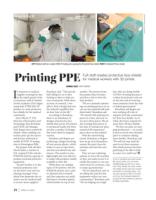
FJA staff creates protective face shields
for medical workers with 3D printer.
Printing PPE
Jews in the D
LEFT: Medical staff at a mobile COVID-19 testing site wearing the 3D printed face shield. RIGHT: A finished 3D face shield
.
COURTESY OF SHANA KANTOR