

Arts&Life
Unorthodox
Netfl
ix show follows Chasidic
runaway to Berlin.
D
espite its cheeky title,
Unorthodox paints a sym-
pathetic portrait of both
the Chasidic community and
one young woman who desper-
ately wants to leave it.
The four-episode Netflix
miniseries, premiering March
26 for our housebound plea-
sure, follows the story of Esther
(Israeli actor Shira Haas of
Shtisel), who cuts off all ties with
her Williamsburg Orthodox
community and flees to Berlin
to start a new life. In so doing,
Esther gets to exhibit more free-
dom than any of us currently
have.
Although it’
s based on the
memoir of the same name by
Deborah Feldman, who also
left her cloistered Chasidic New
York community for Berlin, the
show is largely its own invention.
It doesn’
t look down on Chasidic
or secular life. Instead, series
creator Anna Winger allows
us to fully understand cultures
and customs from every angle,
including more critical ones.
Unorthodox finds a powerful
symbol in modern Berlin: a
city of perpetual destruction
and rebirth, where its protag-
onist finally discovers a sense
of belonging in spite of the
atrocities once perpetuated on
her people here. In Brooklyn,
Esther only spoke Yiddish, only
interacted with other Jews and
wasn’
t allowed to play music. In
Berlin, she can speak English
at a music conservatory with a
multicultural group of friends —
like a secular Israeli with some
blunt thoughts on Chasids. But
Esther’
s self-discovery comes
with rude awakenings, including
the realization she may not have
enough raw talent to fulfill her
lifelong dreams.
These scenes are intercut with
the story of Esther’
s husband,
Yanky (Amit Rahav), desperately
trying to track her down, less out
of love than as a way to save his
social standing in the commu-
nity. But Yanky isn’
t a monster;
he’
s a shy, confused kid who
knows little of the outside world.
Together with his loose-cannon
cousin Moische (Jeff Wilbusch),
the two track Esther to Berlin,
where her mother (who fled
the community years ago) also
lives. What could have been a
tiresome cat-and-mouse chase
becomes more nuanced as these
very different communities col-
lide in unexpected ways.
Jewish identity, in all its
complex forms, is the heart of
Unorthodox. We see Esther use a
mikvah; plan and experience her
own wedding; and bond with
her traditionalist bubbie. And, at
the same time, we see how much
she plainly struggles with the
burden of the community: “God
expected too much of me,
” she
says. The real question is what
she expects of herself.
ANDREW LAPIN EDITOR
40 | MARCH 26 • 2020
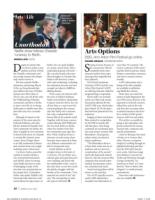
Israeli actor
Shira Haas as
Esther in Netflix’
s
Unorthodox
NETFLIX
Arts Options
DSO, Ann Arbor Film Festival go online.
S
taying at home because of
the coronavirus will not
completely limit enter-
tainment seekers from expe-
riencing what originally had
been planned.
The Detroit Symphony
Orchestra (DSO) and the Ann
Arbor Film Festival (AAFF)
are offering webcasts while live
programming is suspended.
Movie buffs can remotely
watch new films and cinema
discussions planned for the
AAFF’
s 58th year, which takes
place March 24-29, the dates
that had been planned for live
audiences.
Judging of short and feature
films entered in competition
for $22,500 in awards still
will take place. Also being
continued are moderated ques-
tion-and-answer sessions with
filmmakers. All programs,
unless noted, are aimed at
mature audiences.
“The filmmakers deserve
to have their work seen by an
audience and our jurors in
consideration of the awards,
”
said Leslie Raymond, festival
director, who has overseen film
categories that include exper-
imental, documentary, narra-
tive, animated and music.
Award-winning films will be
shown on the final day.
The AAFF typically receives
nearly 3,000 submissions
annually from filmmakers in
more than 70 countries. The
event is a pioneer of the travel-
ing film festival and has visited
theaters, universities, museums
and micro-cinemas interna-
tionally.
AAFF information and a
listing of the film schedule
are available at aafilmfest.
org/58aaff-live-stream.
Music fans can watch the
talents of Jader Bignamini, the
new DSO music director, as he
appeared in archived concerts,
offered live and on the web,
and they also can enjoy other
acclaimed maestros who have
led a variety of DSO perfor-
mances, both live and online.
The archive, accessible by
going to dso.org/replay, cate-
gorizes selections by season,
musical style, composer and
specific presentation.
Listen to Baroque, the music
of today or to various other
styles. Choose a composer
simply by scrolling through an
alphabetical listing and then
hear the DSO play that per-
son’
s works. Selections range
from Brahms’
Concerto for
Violin and Orchestra through
George Gershwin’
s “
An
American in Paris” to Conor
Brown’
s “How to Relax with
Origami” (a world premiere
presentation).
Interviews with performers
also are available.
SUZANNE CHESSLER CONTRIBUTING WRITER
DSO Music
Director Jader
Bignamini in
action
DSO
000_DJN032620_AL Unorthodox march 26.indd 40
000_DJN032620_AL Unorthodox march 26.indd 40
3/23/20 11:12 AM
3/23/20 11:12 AM