

W
hen Erik Bean’
s 17-year-old
son, Ethan, died by suicide,
he was enveloped by a dark
shroud of grief and guilt.
For years, Bean and his wife, Stacey,
who lived in Farmington Hills, had
tried to help Ethan, who struggled with
behavioral issues due to mental health
disorders that included autism, psychosis
and ADHD. Finally, no longer able to
bear his ongoing pain, Ethan ended his
life on Aug. 24, 2018.
“As a parent, you feel like a failure,”
Bean said. “You think about all the
things you could have done.”
After attending a program sponsored
by the American Foundation for Suicide
Prevention, the couple and their daugh-
ter, Blair, began participating in a local
support group for families who had lost
a loved one to suicide. There, Bean met
other survivors who had found that giv-
ing back to their communi-
ties helped ease their grief.
Bean was receptive when
Emily Waszak, a local author
with whom he had previous-
ly collaborated on two class-
room curriculum books,
proposed they co-author a
children’
s book on mental health.
Bean had spent most of his career
in higher education as a professor,
researcher, curriculum designer and
textbook author. Acknowledging there
was a shortage of mental health curric-
ulum geared toward young children, he
agreed to take part in the project. Bean
and Waszak enlisted longtime family
friend Sherry Wexler to serve as editor.
“At first it was a therapeutic device
that got me out of my stupor and mov-
ing forward,” Bean said. “But it also
had the potential to serve a much more
useful purpose, to have a wider positive
impact.”
As the book took began to take shape,
the team recruited local tutor and former
elementary school teacher
Gail Gorske to do the illus-
trations. Described on its
cover as “A Children’
s First
Mental Health Primer,” the
book depicts seven relatable
young characters who strug-
gle with various challenges such as self-
doubt, learning disorders and behavior
issues. In honor of Ethan’
s love of trains
and his April 3 birthday, the story is
structured around a train called Engine
403. Seven children, whose names were
chosen by Blair, board the train to deal
with their respective issues. Stacey, a
social worker, contributed her knowl-
edge of children with atypical behaviors.
In 40 pages of catchy rhymes and 19
Ethan’s
Legacy
Local family creates mental
health primer for children.
RONELLE GRIER CONTRIBUTING WRITER
Jews in the D
COURTESY OF THE BEAN FAMILY
Emily
Waszak
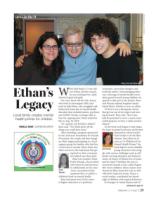
Stacy, Erik and Ethan Bean
Gail Gorske
continued on page 30
FEBRUARY 27 • 2020 | 29