

24 | FEBRUARY 6 • 2020
Jews in the D
continued from page 23
idea that they are going to create
a Palestinian state is kind of a
joke. It’
s not a “Palestinian state,
”
but rather a subject entity with
all controls designated to the
Israelis. The Palestinian state
will be severely fragmented.
“The Triangle,
” which are a
group of Arab towns [located]
in Israel, are now going to be
transferred to the Palestinians.
The Israelis will also have
the power of the veto for any
refugees who try and enter
the Palestinian state, which
will never work because the
Palestinians will never accept
that clause.
The Palestinian textbooks
now must be changed because
they cannot contain anti-
Israeli statements — which,
to be honest, “anti-Israeli” is
defined very loosely. Hamas
will also have to be eliminated,
and that’
s something that is
never going to happen. Also,
Israel is not obligated to fulfill
any of its agreements until the
Palestinians complete all their
agreements, which is just an
excuse to do nothing. This is
a position that Netanyahu has
taken in the past. These are not
sincere efforts.
What have previous adminis-
trations focused on that this
peace plan is lacking?
Stockton: The main dif-
ference between this plan
and previous administrations
is that previous administra-
tions actually dealt with and
focused on fundamental issues.
They understood that both
Palestinians and Israelis had
legitimate concerns and wanted
to attempt to find a solution
to these concerns. In previous
administrations, both Israelis
and Palestinians had agreed
to mutual modifications and
land swaps to the drawn-out
Palestinian state. Even Ehud
Olmert [Israeli Prime Minister
from 2006-09], who was a
Likudist, took that position.
You also need to have some-
one making sure that the holy
sites and the Old City [are] pro-
tected from extremists, because
[they’
re] often a target for vio-
lence. The topic surrounding
refugees must also have some
revisions because right now
Israel can veto who returns to
the country. They can simply
say “no” to someone because
they hold an “anti-Israeli”
view, which, in turn, is any
Palestinian.
However, the most import-
ant takeaway — and the real
issue at hand — is whether we
can prevent another war. The
last time there was an Israeli-
Palestinian conflict, a resistance
to the occupation, the Second
Intifada began and left 4,000
people dead. There is no doubt
that another uprising is going
to occur. I believe that this pro-
posal is making the next war
inevitable.
Do you think this plan can
bring peace to the Israeli-
Palestinian conflict?
Stockton: It’
s not a peace talk
or a peace proposal, because
it’
s never going to produce
anything. You had President
Trump, Netanyahu and Benny
Gantz all there, but who wasn’
t
included? Palestinians. There
are no Arab partners, no
Palestinian partners, and it’
s
totally just unrealistic. And now,
the Palestinians have stopped
cooperating altogether and have
already come out against the
peace plan.
This is similar to the May
17 Agreement. When the
Israelis invaded Lebanon in
1982, they were trying to
work out an agreement with
right-wing Lebanese leaders.
Abba Eban, the famous Israeli
Diplomat, was the negotiator.
[The agreement] provided that
Lebanon would be a security
ally, and that the Syrian army
there at the time would be
pushed out. Abba Eban later
said they sat in a room, spoke
in French, drank white wine
and signed an agreement that
had no support outside of that
room. That right there is pretty
much what you’
re seeing here.
You have an agreement that
only people at that press confer-
ence support. There’
s no effort
to bring the Palestinians to this
agreement.
What’
s your reaction to the
timing of the plan’
s unveiling?
Stockton: The timing of
this is highly ironic. President
Trump is amid his impeach-
ment trial, Netanyahu has been
charged in court with corrup-
tion and they are hanging on
to one another in desperation.
The normal rule is you don’
t do
anything that is going to affect
political outcomes. Trump is
really tied to Netanyahu and
really wants him to be re-elected
and wants to throw him a bone.
This plan gives Netanyahu
the Jordan Valley and big
chunks of the West Bank. There
is no doubt that this is an effort
to help Netanyahu.
What are your methods to
teaching your students about
the Israeli-Palestinian conflict?
Stockton: I’
ve been teaching
at the University of Michigan-
Dearborn since 1973. I started
this course in 1978, when the
Israelis first invaded Lebanon,
with one of my colleagues who
was a specialist in Lebanon.
There was nothing in our whole
university’
s curriculum that dis-
cussed this matter.
I developed some rules that I
give to my students when they
begin my course. I tell students
that they have to assume that
they don’
t understand this con-
flict. They must assume that
all the things they’
ve picked
up from their parents or their
neighborhood are incomplete
or wrong.
I begin by telling them [the]
things that Israelis believe in
their hearts are true, and then
tell them what Palestinians
think in their hearts are true.
You must humanize everything.
I focus on documents and tell
them their job is not to argue
with someone but to under-
stand their position so well that
they can explain it to their sat-
isfaction. Until you can do that,
they won’
t know if they disagree
with them or not.
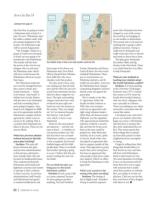
SCREENSHOTS FROM WHITEHOUSE.GOV VIA JTA
Two detailed maps of what a two-state solution could look like.