

44 | JANUARY 30 • 2020
Israeli Health | News
A
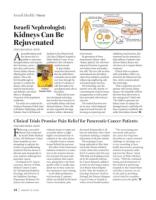
groundbreaking study
has shown that it is
possible to rejuvenate
damaged kidneys and improve
their function, a proce-
dure that could reverse
chronic kidney disease,
offsetting the need for
dialysis. This is the
first breakthrough in
decades to combat this
disease, often precipi-
tated by hypertension
and diabetes, and which
affects a whopping
10 percent of the population
worldwide.
The study was conducted by
Professor Benjamin Dekel, head
of Pediatric Nephrology and the
Pediatric Stem Cell Research
Institute in the Edmond and
Lily Safra Children’
s hospital at
Sheba Medical Center. It was
published in the Cell Reports
medical journal.
In past studies,
researchers discovered
that the adult kidney
constantly renews itself
over time through the
activity of colonies of
cells that replace lost
and degenerated cells in
the kidney.
Dekel and his team
have developed technology
that involves the extraction of
such healthy kidney cells from
diseased kidneys. These cells
are then expanded into large
numbers within a laboratory
environment.
By generation of three-
dimensional cultures called
“kidney spheres,
” the cells show
improved function to generate
new kidney tissue and replace
lost cells. The new cells are then
reintroduced into the kidney
where they rebuild it, positively
influencing neighboring cells
and improving its function.
The technology uses the
patient’
s own cells, thereby cir-
cumventing the need for immu-
nosuppression as well as prob-
lems associated with immune
rejection.
The method has been test-
ed on mice, which displayed
improved renal function. By
focusing on improving and
stabilizing renal function, this
treatment has the potential to
help millions of patients with
chronic kidney disease and
who have yet to require dialysis
treatment.
Clinical trials on patients
with renal failure will be con-
ducted by the KidneyCure Bio
firm, which commercialized
this technology.
“This is important news for
patients with chronic kidney
disease, who hopefully will ben-
efit from these discoveries in
the coming years,
” Dekel said.
“The ability to generate new
kidney tissue (to replace the
damaged tissue) could help mil-
lions of patients worldwide who
suffer from kidney disease.
”
ROLAND METZGER
Professor
Benjamin Dekel
F
ollowing a successful
clinical trial conducted
by Israel’
s Sheba Medical
Center, Tel HaShomer, United
States hospitals are now
attempting to replicate the
results of a groundbreaking
treatment that has shown to
alleviate pain dramatically in
some patients suffering from
pancreatic cancer.
Developed by Dr. Yaacov
Lawrence, director of Sheba
Medical Center’
s Center
for Translational Radiation
Oncology, and Director of
the Radiation Oncology
Department Professsor Zvi
Symon, the treatment uses
radiation beams to target and
accurately deliver a single
highly concentrated dose of
radiation to the celiac plexus
— a bundle of nerve systems
located behind the pancreas.
The effect of the noninvasive
radiation treatment is a reduc-
tion in the extensive discom-
fort and pain that pancreatic
cancer patients often experi-
ence, giving them a far better
quality of life. It usually takes
about two to three weeks for
the treatment to start working.
In the Sheba preliminary
trial involving 21 patients,
which was funded by the Israel
Cancer Association, pain
decreased dramatically in all
but one individual, with a third
of patients claiming a complete
elimination of all pain entirely.
The technique is now
being replicated at Ohio State
University Wexner Medical
Center, where they treated the
first U.S. patient early this year.
With help and funding provid-
ed by the nonprofit Gateway
for Cancer Research, addition-
al trials are also being conduct-
ed at Mount Sinai Hospital
in New York, the Institute of
Oncology Francisco Gentil in
Portugal, the Princess Margaret
Cancer Centre in Canada as
well as several Israeli locations.
“The excruciating pain
associated with pancre-
atic cancer has long been
described as a great unsolved
challenge in oncology, so it
is very rewarding to have
finally discovered a promising
solution for patients suffer-
ing from the illness,” stated
Lawrence of Sheba Medical
Center. “With the continued
testing and development of
this method at partnering
hospitals in the United States
and other countries, we are
on the path to providing
critical relief for countless
patients across the globe.”
Israeli Nephrologist:
Kidneys Can Be
Rejuvenated
Clinical Trials Promise Pain Relief for Pancreatic Cancer Patients
FROM SHEBA MEDICAL CENTER
FROM SHEBA MEDICAL CENTER