

JANUARY 30 • 2020 | 37
continued on page 38
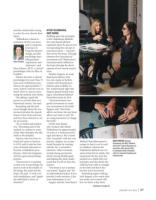
BOTH PHOTOS: Brenda
Rosenberg and MELT Method
instructor Leanne Bourassa do
exercises with special balls
to stimulate fluid in Brenda’
s
cells for improved healing and
reduced pain.
ated the method after trying
to solve his own chronic knee
injury.
“Feldenkrais is based in
awareness of how you move
and in using this
awareness to
bring the desired
change, just like
psychology does
with personal
experiences and
behaviors,” said
Hava Schaver, Ph.D., a clinical
psychologist with an office in
Franklin.
Schaver has been a clinical
psychologist for more than 35
years and a Feldenkrais prac-
titioner for approximately 17
years. Schaver said she uses no
touch when it comes to prac-
ticing the method with clients.
“By talking, I guide the
person to activate their own
intentional system,” she said.
Rosenberg said she had
never thought about the con-
nections between the muscle
tissues of her body and bone
and how those interact to cre-
ate movement.
“It’
s so tender and unintru-
sive,” Rosenberg said of the
method, in contrast to some
of the other therapies she did
while in the hospital.
Schaver, who was born in
Israel and came to America
in 1974, said it took her four
years of formal education to
become a Feldenkrais prac-
titioner, which she integrates
with her general psychology
practice.
“Neuroscience is teaching
us that even in psychology we
need to look at the totality of
the being, the mind and the
body,” she said. “I work a lot
with mindfulness, and I guide
the individual to form an
intention.”
AFTER FELDENKRAIS,
ANAT BANIEL
Building upon the principles
of the Feldenkrais Method,
the Anat Baniel Method
expanded upon the practice by
incorporating the concept of
neuromovement — exercises
that rewire the brain. Through
intention but also physical
movements and “distinctions,”
neuromovement influences
the brain through the devel-
opment of new neural connec-
tions.
Heather Sjogren, an Anat
Baniel practitioner with
her own studio in Berkley,
worked with Rosenberg to
help her gain mobility on
her compromised right side.
Sjogren gained formal train-
ing in Anat Baniel Method
NeuroMovement in 2015.
“Neuromovement uses
gentle movements to create
new movement in the body,”
Sjogren said. “Our body
affects our brain, but our brain
affects our body as well. We
are using movement to change
the body.”
Israeli Anat Baniel,
who worked with Moshe
Feldenkrais for approximately
10 years, is a clinical psychol-
ogist and dancer. She created
nine “essentials” with her own
practice. Sjogren, an occupa-
tional therapist by training,
said the No. 1 essential is
intention. Other essentials
include doing movements
slowly, having flexible goals
and helping the client under-
stand that it’
s OK to have lim-
itations.
“Our brain is not a mechan-
ical system,” Sjogren said. “It’
s
an informational system. If you
provide it with variation, it has
more information to use.”
Sjogren said the Anat Baniel
Method NeuroMovement is
unique in that it can be used
on children, whereas the
Feldenkrais Method was cre-
ated exclusively for adults. She
mentioned she has used the
method on a child with cere-
bral palsy and that slowly the
child has been able to straight-
en his limb and that it has
become more functional.
Rosenberg began working
with Sjogren a few weeks after
her stroke and worked with
her two times a day, three
Hava Schaver