

JANUARY 23 • 2020 | 29
Jews in the D
Matthew and Connor
Tukel’
s drone.
PHOTOGRAPHY COURTESY OF MATTHEW TUKEL
response data set from the
Detroit city controller to help
them gather the data points
and distances they needed to
test the drone for.
Next, they conducted 50
flight trials with the drone
across seven different straight-
line distances. The data col-
lected at the end of the trials
proved that the drone travel
times are faster than ambu-
lance arrival times.
“We wanted to have a ref-
erence as to what a paradigm
was currently for Detroit
first responders responding
to the scene of
opioid overdoses,
”
Matthew said.
“We took their
data and com-
pared it to ours
that we acquired,
and we found that
our drone was as
fast, if not faster,
than Detroit’
s
first responders.
”
If cities do incorporate
drones, they would need to
develop drone deployment
centers near high overdose
areas. The brothers shared
that these centers would allow
for drones to be quickly sent
out to reach the patient and
empower bystanders to assist
before the arrival of first
responders.
Matthew recently presented
his findings during a presen-
tation titled “Time-to-Scene
for Opioid Overdoses — Are
Unmanned Aerial Drones
Faster than Traditional First
Responders in an Urban
Environment?” at the
Michigan American College of
Physicians’
annual meeting in
Grand Rapids.
He won first place in the
medical student category and
earned a spot to travel to Los
Angeles in April to present
at the National American
College of Physicians’
meeting.
The brothers have now sub-
mitted a more extensive man-
uscript of their findings to the
British Medical Journal with
hopes of it being published.
“The significance of the
publication is that it will val-
idate the concept,
” Matthew
said. “It will then open up the
door and start a conversation
saying that
this might be a
solution to this
big problem.
”
While the
findings show
positive results,
there is still
more research
that needs
to be done
before we see
drones delivering the medica-
tions.
“We validated the intuition
that a drone can travel fast-
er than an ambulance in an
urban environment,
” Connor
said. “The trials were very
controlled, and we need to
now look at real-world practi-
cal considerations.
”
The brothers credit much
of their success to their family
and Jewish upbringing.
“We learned the values of
empowerment and feeling like
you had a responsibility to do
something to improve the lives
of other people and had that
ingrained in us throughout
our lives,
” Connor said.
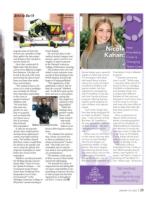
Matthew Tukel piloting the drone.
How
Friendship
Circle is
Changing
Teens Lives
TWENTY-FIVE YEARS
Nicole Kahan was a seventh
grader at Hillel Day School
in Farmington Hills when
she heard about a place
where she could volunteer
to befriend children with
special needs. Her first
experience volunteering
with Friendship Circle was
with the Friends at Home
program offering families
respite and friendship for
their children with special
needs.
“I will never forget that
first day being dropped off
to meet my Buddy,” Kahan
says. “I was nervous at first.
But then, all I needed to
do was spend time with her
and be a friend. That visit
changed everything for
me.”
Kahan was so committed
to the impact she was able
to have on each Buddy’s
life that she began vol-
unteering weekly. In high
school, she was a regular,
volunteering almost every
day after school and on the
weekends at Friendship
Circle. She is also one of
the first board members for
Friendship Circle’s UMatter
program.
“I started coming any
time I could,” Kahan says.
“I was here after school for
Social Circle on Tuesdays,
Life Skills on Wednesdays
and Sunday Circle, too.
I worked with different
Buddies all the time and
learned so much about how
to find a way to connect
with even the most difficult
kids to help them feel like
they had a place to have
fun here.”
Now a sophomore at
Wayne State University,
Kahan is studying psychol-
ogy with an emphasis on
Applied Behavior Analysis.
Her decision to study psy-
chology is due in large part
to her work at Friendship
Circle. Kahan drives back
every Sunday to work as a
leader at Sunday Circle.
“Honestly, without
Friendship Circle, I’d be so
sad. When people ask me
where I see myself in 10
years, I tell them, I hope it’s
working at Friendship Cir-
cle,” Kahan says. “Everyone
Get involved,
go to
friendshipcircle.org/
foreverfriendship
Nicole
Kahan: