

COURTESY OF HERSCHEL FINK
Detroit Police Department, led by then-
Chief Police Commander (and later City
Council President) Gary Brown, who
told Dre’
s concert promoters backstage
that power to the show would be cut if
the explicit video was shown. The tour,
not wanting to disappoint the thousands
in the audience, agreed to pull the video.
The exchanges were openly recorded by
a tour film crew.
“The video didn’
t show anything you
wouldn’
t see on a Sunday night on the
Sopranos,
” said Fink, who was called in to
defend Dr. Dre.
The next day, the tour was scheduled
to go to the Palace of Auburn Hills.
Fink went to federal court that day and
obtained an injunction from U.S. District
Court Judge Nancy Edmunds to prevent
any interference with the show by police.
The show at the Palace featured the
explicit video introduction.
When the tour left Michigan, the pro-
moters sued Detroit and settled for their
attorney fees. Former Mayor Dennis
Archer issued a public statement that
conceded the possibility of an unconsti-
tutional “prior restraint” on behalf of the
Detroit Police officers.
Six months later, Dre and his produc-
ers released a DVD of the tour with some
bonus tracks that included a 10-minute
segment titled “Detroit Controversy,
”
depicting the heated exchanges between
the police and promoters at the Joe Louis
show. The officers in the video sued on
eavesdropping and other tort theories.
At first their case was tossed out, but on
appeal the court said dismissal of the
claim was premature.
“The wheels of justice turn slowly,
”
Fink said. The case bounced between
courts for nearly a decade before finally
reaching the Michigan Supreme Court,
which ruled in Dre’
s favor.
RESPECT OF JOURNALISTS
At the Hensel Award event, former
reporter David Ashenfelter said in a
video tribute, “I’
m one of many reporters
Herschel has bailed out of trouble over
the years.
”
During the 1990s, Ashenfelter wrote a
series of stories about a Wayne County
judge accused of using racial and ethnic
slurs in phone conversations with her
ex-husband. She was trying to use her
position to convince police he was at
fault in their child custody dispute.
Ashenfelter got the tapes from the
estranged husband. “We ran a story in
the Free Press that was hugely controver-
sial. She sued us both for $100 million in
federal court. Here’
s what happened: She
got booted off the bench. With Herschel’
s
help, I got removed from the lawsuit.
”
Fox 2 News reporter Ron Wolcheck,
well-known for his “Hall of Shame” seg-
ments, called Fink a “real bulldog” in a
video tribute. “Herschel Fink really likes
me because, quite frankly, I get sued a
lot and he gets to defend me and make
a lot of money. But because of my great
reporting and Herschel’
s great lawyering,
we always win.
” In his trademark gravelly
voice, he added, “Herschel Fink, you’
re in
the Hall of Fame!”
According to Detroit Free Press Editor
Peter Bhatia, “(Fink) has a way of telling
lawyers and city officials that the law is
on our side, and he does it with humor
and incredible effectiveness. I think every
news organization needs someone like
Herschel … If we don’
t have people like
Herschel fighting for us, ultimately our
freedoms are at risk.
”
FINK ON
HATE SPEECH
“My problem with shutting down hate
speech is how do you define it? Do you
define it as anything? Any speech that
disturbs your sensibilities?” he asked.
“If so, then you are throwing out the First
Amendment.”
According to the Supreme Court, he said,
unless speech is going to inspire imminent
violence, it has to be allowed.
“A recent Pew Research Center survey
found 49 percent of college students do not
support free speech if it’
s designated as
‘
hate speech.’
That basically translates to
a desire to censor speech they don’
t agree
with or that disturbs their sensibilities or
their wrongheaded idea that universities
must be ‘
safe places’
free from disturbing
ideas.
“Of course, the opposite should be the rule
at colleges and universities,” he continued.
“In other words, they have no understanding
of nor tolerance for the very concept of free-
dom of speech, the concept that underlies
the First Amendment.
“Once you start censoring speech, where
do you stop? That’
s a difficult national
debate, but I think it comes back to the core,
a free marketplace of ideas and that dissent-
ing voices should be allowed to be heard.
“These are issues that are going to have
to be hashed out over a period of time and
we’
ll see how that turns out. But I’
m very
bothered by the lack of tolerance for dissent-
ing opinion, principally conservative opinion,
which is being taken as hate speech.”
32 | JANUARY 9 • 2020
“Once you start censoring speech, where do
you stop? That’s a diffi
cult national debate,
but I think it comes back to the core, a free
marketplace of ideas and that dissenting voices
should be allowed to be heard.”
— HERSCHEL FINK
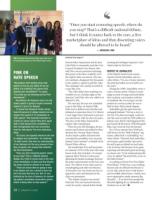
TOP: Herschel Fink and his family pose with one of
his early press passes at the Hensel Award event.
Jews in the D
continued from page 31