
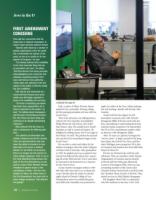

PHOTOS BY ANTHONY LANZILOTE
continued from page 29
30 | JANUARY 9 • 2020
Fink, a native of Metro Detroit, always
aspired to be a journalist. During college,
his first paying journalism job was with the
Jewish News.
“Part of its attraction was talking history
with Jewish News founder and publisher
Philip Slomovitz. His stories were better
than history class. He actually knew Israel’
s
founders as well as America’
s leaders. He
delighted in telling stories, and I was eager to
hear them,
” he said. “My passion for journal-
ism and the First Amendment began at the
Jewish News.
”
He was also a writer and editor for his
student newspaper, then the Daily Collegian
at Wayne State University. After graduation
in 1963, he applied and was accepted to law
school, but deferred the option for a report-
ing job at the Flint Journal. A few years later,
he returned to his hometown as a reporter
for the Detroit News.
A nine-month newspaper strike in 1967
left Fink with extra time to re-evaluate his
career. Shortly after the strike, he started
night school at Detroit College of Law.
During those years, he worked the grave-
yard shift and eventually was promoted to
night city editor at the News while studying
law and starting a family with his late wife,
Annette.
Armed with his law degree, he left
journalism to practice law with Detroit’
s
Honigman Miller Schwartz and Cohn law
firm, specializing in representing local and
national media companies. He represented
the JN on First Amendment matters while
an attorney with Honigman Miller.
After 35 years as a partner, he began his
“encore career” as legal counsel for his long-
time client, the Detroit Free Press, and five
sister Michigan news properties. He is also
of counsel at the business law firm Jaffe Raitt
Heuer & Weiss P
.C.
He lives in Orchard Lake with his wife,
Adrienne. They are members of the Zionist
Organization of America and are heavily
involved with the Holocaust Memorial
Center in Farmington Hills. Fink was also
a founding member of the Great Lakes
Chamber Music Festival and is involved with
the Chamber Music Society of Detroit. They
attend services at Adat Shalom Synagogue.
His daughter, Sheri Fink, is a physician
who left medicine to become a New York
FIRST AMENDMENT
CONCERNS
Fink said he’
s concerned with the
media bias in national newspapers in
today’
s hyper-partisan political climate.
“Opinion polls taken by a number of
polling organizations show the public
has a remarkably low opinion of the
press, as low as or similar to its low
opinion of Congress,” he said.
“I’
ve always believed that credibility
is the most important thing that we
as journalists can have,” he added.
“And that derives from being accurate,
acknowledging errors, being fair and
unbiased, separating opinion from
news and factual news gathering …
I think what was reflected in the low
opinion of the public is that the media
has lost credibility.”
Fink said he was heartened by a
recent poll that showed local news
media was still highly regarded in
terms of its credibility and accuracy.
“The kind of watchdog journalism
that local news organizations do is
what is important to the public,” he
said. “I’
m talking about newspapers
and the kind of watchdog journalism
the Free Press has been doing and
continues to do despite diminishing
resources.”
What disturbs Fink the most, he
said, is intolerance for differing opin-
ions.
“It’
s endemic at universities and
college campuses around the country.
There are demonstrations that shut
down the ability of students to hear
both sides of an issue or political
debate. For all intents and purposes,
there is no longer any free speech on
many college campuses. That, to me, is
the most disturbing thing because the
basis of the First Amendment, as was
said by Justice Oliver Wendell Holmes:
‘
Freedom of speech means a free
marketplace of ideas.’
This free mar-
ketplace of ideas, the whole basis of
the First Amendment, has been lost on
many college campuses. That disturbs
me greatly.”
Jews in the D