

DECEMBER 12 • 2019 | 47
Open Access
Israel’
s National Library collaborates
with Google to digitize 120,000 books.
UNITED WITH ISRAEL STAFF
Eretz
I
n a historic collaboration
between the National
Library of Israel (NLI)
and Google, some 120,000
books will be digitized,
the NLI announced. It will
include all the library’
s
collection of out-of-
copyright works that have
not yet been digitized as
well as every book published
during the first 450 years of
Hebrew printing.
About half of the books
are in Hebrew, Yiddish and
Ladino (Judeo-Spanish).
The rest include a variety
of languages such as Latin,
English, Arabic, German and
French.
Inclusion of these books
“significantly increases the
percentage of Hebrew texts
available through Google
Books,” noted the NLI
statement.
“The project is part of
the Google Books Library
initiative, which includes
more than 40 million
books from more than 70
of the greatest libraries in
the United States, Europe
and Japan, as well as from
thousands of publishers. It
includes books in over 400
languages,” according to the
news source NoCamels.
The Google Books project
was launched 15 years ago.
Its goal is to digitize every
book throughout the world
in order to make them
searchable for all.
Head of library
partnerships at Google
Books Ben Bunnell said
this “partnership brings a
rich collection of Hebrew
language materials to the
corpus and takes us a
significant step closer to
realizing our mission.”
The “complex” project
is expected to take about
two years. It requires the
use of state-of-the-art
shipping containers that
meet strict climate-control
and security requirements
to transport the books from
the NLI in Jerusalem to the
Google digitization center
in Germany. Every book
must then be scanned and
returned to Jerusalem each
month.
Included in the
digitization process are the
1853 book The Interpretation
of Dreams in Zhovkva,
Ukraine, originally published
by Rabbi Manasseh ben
Israel (1604-1657) in which
the significance of dreams
from a Jewish perspective
is discussed, drawing from
the Talmud, the Zohar and
Western philosophy; The
Five Books of Moses: Tzena
U’
rena, a 1785 Yiddish
translation and adaptation
of the Torah, first written
in 1509 and “intended
primarily for women who
were typically not educated
enough to study the original
biblical text,” according to
NoCamels; and Sefer Me’
Am
Loez, an 1823 collection
of Midrash teachings of
the sages on the Bible,
considered the “crown jewel
of Ladino literature,” will
also be digitized, according
to the statement.
Yaron Deutscher, head of
digital access at the National
Library of Israel, said that
the organization was “very
happy to be working with
Google in fulfilling our
mission to open access to the
treasures of Jewish, Israeli
and universal culture for
diverse audiences across the
globe.”
Israeli National Lottery
Bets on Saving Lives
UNITED WITH ISRAEL STAFF
T
he Israeli National
Lottery (Mifal
HaPayis) has invested
NIS 5 million ($1.34 mil-
lion) to install defibrilla-
tors outside of 600 lottery
booths throughout Israel
to reduce deaths associated
with cardiac arrest.
Defibrillators give an
electric shock to the heart
when people experience a
cardiac incident. Studies
show their immediate use,
along with CPR, signifi-
cantly increases the likeli-
hood of patients regaining
consciousness and prevents
deterioration that results
from delays in treatment.
“The goal of this initia-
tive is to save lives,” Avigdor
Itzhaky, chairperson of
Mifal Hapayis, said, accord-
ing to reports. “The deploy-
ment of defibrillators in
the stands of Mifal Hapayis
throughout the country
could allow, in certain situ-
ations, immediate primary
treatment in a public space
and, possibly in certain sit-
uations, even save the lives
of the sick from the most
common cause of death in
the country and around the
world — heart failure.”
The devices will be avail-
able to the public, even
when lottery booths are
closed.
The defibrillators connect
wirelessly to Magen David
Adom (MDA) stations.
Passersby can call MDA
and receive instructions to
help people in distress until
an MDA professional can
be dispatched. The defibril-
lator also has audio instruc-
tions that explain how to
administer electric shocks
to the patient.
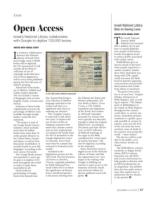
NATIONAL LIBRARY OF ISRAEL
A mid-18th century Hebrew manuscript