

Jews in the D
T
hree young speakers
presented their stories
of resilience at the
third annual Teen Shabbat
Dinner on Friday, Nov. 22, at
Friendship Circle. About 200
teenagers heard from Emily
Coon, Mandi Fealks and
Brandon Klein.
Coon, 16, spoke about
developing depression after
losing her sister to suicide.
“Her laugh was contagious.
It could make anyone happy
even on their worst day,” Coon
said of her sister who was 18
years older. She passed when
Coon was 5 years old. When
she was 6, Coon was diag-
nosed with depression.
“Losing someone you love is
the feeling of not being able to
breathe,” she said. “The worst
part is losing someone who
didn’
t want to stay.”
When she was 9 years old,
Coon’
s struggle with mental
health turned into a physi-
cal battle. She experienced
extreme pain in her legs with
no known cause. After a few
weeks, she lost the ability to
walk.
“I could barely stand or take
more than two steps without
my legs turning to Jello and
collapsing beneath me,” Coon
said.
It took months of hospital
visits and countless tests, but a
doctor finally diagnosed Coon
with conversion disorder, a
condition of paralysis or other
neurological symptoms that
cannot be explained by medi-
cal evaluation. This is usually
brought on by mental illness.
Coon said it only took one
night of happiness to get her
walking again. When she went
to a concert with her mom,
she entered the venue in a
wheelchair and left on her
own two feet.
She was improving, but
she started to harm herself in
2014. With support from her
best friend and family mem-
bers, Coon spent five days in a
mental hospital in 2016.
“I felt refreshed and ready to
continue fighting the battle in
my mind because life really is
worth living,” she said. “I am
here for a reason.”
Fealks, 16, opened up about
her cousin Allison who com-
mitted suicide in the summer
of 2018. Fealks was away at
summer camp, so she never
got to say goodbye.
“What if I had texted her?
What if she knew I was there
for her? What if she knew I
was struggling, too?” Fealks
said. “I have always struggled
with anxiety and depres-
sion, but after that summer,
my depression episodes got
worse.”
She struggled through
the school year with lit-
tle improvement until she
returned to camp in 2019.
Her friends and counselors
encouraged her to write a
letter to Allison, tie it to a bal-
loon and let it go.
“I will move forward, and
I will go on with my life,”
Fealks said in the last line of
the letter.
Klein, 26, explained how
he uses meditation and jour-
naling to live with obses-
sive-compulsive disorder. The
Jewish News featured Klein
when he left the University
of Michigan to create the
WiseMindGentleSoul medita-
tion center.
“In my mind, I would get
running, running, running
thoughts. Obsessive thoughts,”
he said. “By tapping into
my breath, by noticing my
thoughts, by not pushing them
away but not diving in, I felt
better.”
Klein had little success
with therapy and medication.
Luckily, he discovered medi-
tation when he was 20 years
old. He said he found a way
to handle his mind, but his
struggles didn’
t go away.
“This is not the end of the
story because I’
m still living
it,” Klein said. “Suffering is
inherent to human existence.
We’
re all suffering. One way
you can suffer less is to shine
light on the darkness.”
Two professional football
players, Miles Killebrew and
Trevor Bates, spoke at last
year’
s Teen Shabbat Dinner.
The teens were excited but,
ultimately, they preferred
hearing from their peers, said
Yarden Blumstein, teen direc-
tor at Friendship Circle.
“Teens want a setting they
created that’
s theirs,” he added.
“It’
s a story-sharing platform
to show strength and hope.
They can open these dia-
logues.”
Audience member Lindsay
Zousmer, 15, was moved by
the speakers.
“The way they explained their
stories was so raw and real,
” she
said. “Never be afraid to share
your story. You never know the
impact it will have.
”
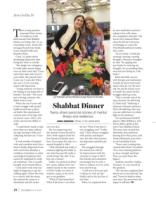
Lexi Finkelstein and Inez Mundrine arrange flowers for the tables.
18 | DECEMBER 12 • 2019
Shabbat Dinner
Teens share personal stories of mental
illness and resilience.
JENNA ANDERSON SPECIAL TO THE JEWISH NEWS
EILEEN PLUNKETT