

Views
To make a donation to the
DETROIT JEWISH NEWS FOUNDATION
go to the website
www.djnfoundation.org
The Detroit Jewish News (USPS 275-520) is published every Thursday at
29200 Northwestern Highway, #110, Southfield, Michigan. Periodical postage paid at
Southfield, Michigan, and additional mailing offices. Postmaster: send changes to:
Detroit Jewish News, 29200 Northwestern Hwy., #110, Southfield, MI 48034.
8 | NOVEMBER 21 • 2019
1942 - 2019
Covering and Connecting
Jewish Detroit Every Week
jn
Arthur M. Horwitz
Executive Editor/Publisher
ahorwitz@renmedia.us
F. Kevin Browett
Chief Operating Officer
kbrowett@renmedia.us
| Editorial
Associate Editor: Jackie Headapohl
jheadapohl@renmedia.us
Story Development Editor:
Keri Guten Cohen
kcohen@renmedia.us
Digital Editor: Allison Jacobs
ajacobs@renmedia.us
Multimedia Reporter: Corrie Colf
ccolf@renmedia.us
Staff Photographer/Videographer:
Derrick Martinez
dmartinez@renmedia.us
Social Media Coordinator:
Chelsie Dzbanski
cdzbanski@renmedia.us
Editorial Assistant: Sy Manello
smanello@renmedia.us
Senior Columnist: Danny Raskin
dannyraskin2132@gmail.com
Contributing Editor: Robert Sklar
rsklar@renmedia.us
Contributing Editor: David Sachs
Contributing Arts Editor: Gail Zimmerman
gzimmerman@renmedia.us
Contributing Writers:
Nate Bloom, Chella Bluth, Suzanne
Chessler, Annabel Cohen, Ben Falik,
Stacy Gittleman, Judy Greenwald,
Mark Jacobs, Chelsea Landry, Jennifer
Rosenberg, Jeremy Rosenberg, Mike
Smith, Steve Stein, Elana Weberman
| Advertising Sales
Vice President of Sales and
Business Development: Carol Kruemmer
ckruemmer@renmedia.us
Sales Manager: Keith Farber
kfarber@renmedia.us
Account Executives:
Kelsey Cocke, Annette Kizy
Sales Support:
Sarah Busemeyer, Ashlee Szabo
| Business Offices
Billing Coordinator: Pamela Turner
| Production By
Farago & Associates
Manager: Scott Drzewiecki
Designers: Jessica Joannides,
Kelly Kosek, Michelle Sheridan,
Susan Walker
| Detroit Jewish News
Partner:
Arthur M. Horwitz
ahorwitz@renmedia.us
Partner:
F. Kevin Browett
kbrowett@renmedia.us
Partner:
Michael H. Steinhardt
Operations Manager:
Andrea Gusho
agusho@renmedia.us
How to reach us see page 10
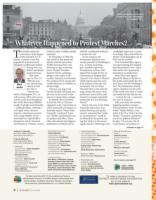
Moratorium March to End the War
in Vietnam was held in Washington
D.C., November 1969.
Whatever Happened to Protest Marches?
T
his month marks the
anniversary of the largest
political protest in U.S.
history, a seismic event that
gripped all of America and
should be recalled and studied
during these tur-
bulent and deeply
polarized times.
Fifty years
ago, on Nov. 15,
1969, the mas-
sive Moratorium
March to End
the War in
Vietnam was
held in Washington, D.C., as
well as many other cities across
America and even throughout
the world. More than 500,000
people of all ages and ethnicities
— political leaders, celebrities,
civil rights icons, veterans,
students, entertainers, parents
with young children in tow —
descended on Capitol Hill to
demand an end to America’
s
involvement in Vietnam. Across
America some 2 million people
protested.
By November of 1969, the
war, which at that point had
already claimed more than
45,000 American lives, was
showing no sign of slowing
down. Despite President
Richard Nixon’
s campaign
pledge a year earlier to de-
escalate America’
s involvement,
the number of U.S. troops had
swelled that year to 550,000, an
all-time high.
America was angry and
fiercely divided, and many peo-
ple were in the mood to take
action to express their outrage.
In Detroit, the Committee
to End the War in Vietnam
organized a city-wide protest in
which thousands converged on
Kennedy Square. Wayne State
University conducted “teach-
ins,
” debates, and featured activ-
ist speakers and films. Many
other educational and religious
institutions in Detroit and its
suburbs coordinated seminars
to protest the war.
Across America, the
Moratorium Marches were
mostly peaceful. In Washington,
D.C., Coretta Scott King
led a candlelit vigil down
Pennsylvania Avenue. Folk
legend Pete Seeger led the sea
of protesters in singing John
Lennon’
s “Give Peace a Chance,
”
which had become the unof-
ficial anthem of the anti-war
movement. The trio Peter,
Paul and Mary came onto the
stage, along with many other
performers and activists, and
joined in as Seeger repeatedly
interjected “
Are you listening,
Nixon?”
Nixon, who was in the White
House the entire time, was
indeed listening and quickly
issued a statement that “under
no circumstances” would he
be affected by the protest, stat-
ing that “policy in the streets
equals anarchy.
” Referring to the
candlelight vigil led by Coretta
Scott King, Nixon joked that he
should “send helicopters out to
blow out the candles.
”
Vice President Spiro Agnew
was also listening and charged
that the protesters were “impu-
dent snobs who characterize
themselves as intellectuals.
”
Both Nixon and Agnew
placed the blame at the feet of
the media, particularly the New
York Times and the Washington
Post. The Moratorium March,
Agnew claimed, was the work
of the media who were a “small
and unelected elite that do not
— I repeat, do not — represent
the view of America.
”
Fifty years later, the broader,
lingering questions remain:
Did the protests work? Do they
today? Nathan Heller, a jour-
nalist at the New Yorker, has his
doubts. “Is protest a productive
use of our political attention?”
he asks. “Or is it just a bit of
social theater we perform to
Mark
Jacobs
WIKIPEDIA
essay
continued on page 10