

18 | NOVEMBER 21 • 2019
Discovery
of a
Family
Dynasty
Woman uncovers her
ancestry during March of
the Living trip.
JUDY GREENWALD CONTRIBUTING WRITER
A
s the self-proclaimed historian
of her family, former Detroiter
Rita Morse has always been
interested in her family’
s roots. As the
child of Holocaust survivors, however,
Morse (nee Jerusalem) always believed
those roots weren’
t very deep.
But during a recent trip to Poland as
a participant in the 2019 International
March of the Living, not only was she
able to locate her grandmother’
s and
great-grandparents’
graves in the Lodz
cemetery, she was also overwhelmed
with the discovery of ancestral ties to a
renowned 18th-century Chasidic rabbi,
the Strykower Rebbe, Ephraim Fishel,
known as the “Pillar of Fire.”
Morse, who with husband, Marc,
now lives in Hollywood, Fla., knew her
father Bernard was from an Orthodox
family in Lodz and was imprisoned in
the Lodz Ghetto, where he lost his wife
and 6-year-old son. Morse’
s mother,
Adina, was born in Czechoslovakia
and, during WWII, she worked in a
forced-labor camp in Riga, Latvia, and
managed to escape the Nazis during a
death march.
After the war, they both ended
up in a displaced persons camp in
Austria, where they met and married.
Then, with assistance from family
in America who were elated that
relatives had survived the Holocaust,
Morse’
s parents also managed to get
out of Europe and, as passengers on a
military ship, arrived in New York in
late November.
“My parents’
first meal in America
was Thanksgiving dinner,” she
noted with emotion. “That’
s why
Thanksgiving is a very important
holiday in my family.”
UNCOVERING A SURPRISE
Other family facts helped Morse delve
deeper into her history.
“I knew in order to avoid the Polish
draft, my father’
s older brother Leo
emigrated to the U.S. after World War
I and eventually settled in Detroit,” she
said. “In communicating with family
still in Poland, Leo found out his
mother (my grandmother Sara) died
in May 1939 and was buried in the
Lodz cemetery. He received a copy of
her death notice, written in Polish and
Yiddish.”
It was when her cousins sent her
this notice her interest in finding her
grandmother’
s grave was piqued. This
search would coincide with another
activity she had already signed up for:
the March of the Living, which took
place April 30-May 12. The event is an
annual educational program bringing
people from around the world to
Poland and Israel to study the history
of the Holocaust and march down the
same path leading from Auschwitz to
Birkenau on Holocaust Remembrance
Day — Yom HaShoah — as a tribute to
all victims of the Holocaust.
“I joined the march because, being
a child of survivors, I wanted to feel
empowered by the number of Jews
continued on page 20
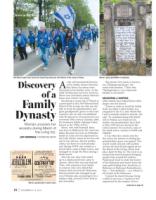
Morse’
s great-grandfather’
s headstone
COURTESY OF RITA MORSE
Morse’
s grandmother’
s death notice
Rita Morse (right front) carries the Israeli flag during the 2019 March of the Living in Poland.
Jews in the D