

44 | NOVEMBER 14 • 2019
Eretz
Symbol of Hope
An olive tree was planted at
a Jewish winery in memory
of a beloved deceased
Palestinian worker.
I
srael’
s Gush Etzion
Winery memorialized a
Palestinian worker who
died suddenly from a brain
hemorrhage two weeks
ago. A group of Jews and
Palestinians joined forces to
plant an olive tree, a symbol
of peace, in front of the
winery.
Shadi Assad, 25, from
the village Khallet Sakariya
in the Gush Etzion region
outside of Jerusalem, had
worked at the Gush Etzion
Winery’
s restaurant for five
years as a cleaner.
Last month, Assad
complained of head pain.
He was taken to a medical
clinic in Bethlehem, where
he was told that nothing
serious was wrong. One
week later, Assad died
of a brain hemorrhage.
Following a
condolence visit by
the winery’
s owner,
Shraga Rozenberg, to
the Assad family, his
colleagues decided to
plant an olive tree in his
memory.
Biblically, the olive
tree represents peace
and comfort. However,
presently, the olive tree is
often portrayed in the news
as a point of contention
between Jews and
Palestinians.
In Israel, planting
trees (usually olive trees
as they grow well in hill
country) establishes
squatter ownership rights
on property. This creates a
“land grab” between Jews
and Palestinians.
Assad’
s olive tree is meant
to symbolize hope for
peace between the clashing
cultures. Alongside the
tree is a large stone with
both Hebrew and Arabic
inscriptions.
The inauguration was
attended by local rabbis,
staff, family and friends
from both the Jewish and
Muslim communities.
Following the event, one
winery employee wrote,
“I don’
t know what peace
would be like and how to
bring it, but I know that a
few hours ago I experienced
a moment of peace. I feel
the crazy complexity,
the anger — but also
neighborly and humane
feelings.”
In a video, Rozenberg
and Muhmad Assad, the
father of Shadi, sit together
and explain their feelings
about Shadi and the tree
planting.
Muhmad said that he
witnessed the love that the
winery staff had for his
son, noting that they cried
along with him. Rozenberg
shared that he wanted to
comfort the family with the
memorial.
The video ends with
both men expressing
similar sentiments, hoping
for peace in their native
languages.
UNITED WITH ISRAEL STAFF
YOUTUBE SCREENSHOT
UNITED WITH ISRAEL
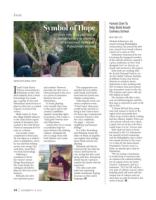
Shadi Assad
Famed Chef To
Help Build Israeli
Culinary School
NEW YORK (JTA)
Michael Solomonov, the
award-winning Philadelphia
restauranteur, has joined the advi-
sory council of an Israeli culinary
school set to open in 2021.
Solomonov announced he was
becoming the inaugural member
of the school’
s advisory council at
a press conference in New York
alongside Lior Lev Sercarz, an
Israeli chef involved in the project.
Both chefs are working with
the Jewish National Fund to cre-
ate the Galilee Culinary Institute
at Kibbutz Gonen near Kiryat
Shmona in northern Israel.
Solomonov is also working with
JNF to build a food and technol-
ogy innovation center in the city.
The institute and center will cost
$29 million to build.
The institute will offer a four-
year accredited program, and the
first class is expected to start in the
fall of 2021.
“I always felt bad that young
men and women in Israel or the
region don’
t necessarily have
where to go to learn about cooking
and the culinary studies. There are
a few private schools now, which
is great, but not at the scale that I
would want it to be,” Sercarz said.
Both chefs are born in Israel
but based in the U.S. Solomonov
has opened several restaurants,
and his Philadelphia eatery Zahav
was named the best in the coun-
try in May by the James Beard
Foundation. Sercarz owns La
Boite, an upscale spice shop in
Manhattan.
“We are seeing a renaissance
in Israeli food as American din-
ers embrace the cultural melting
pot of cuisines from my home
country,” Solomonov said in a
statement. “GCI by JNF will be a
new type of culinary school, where
budding chefs will work with the
unique mix of cultures and cui-
sines that can only be found in the
north of Israel.”