

NOVEMBER 7 • 2019 | 45
ELLEN KAHN’
S STORY
Ellen Herz Kahn of Franklin and
her sister Margaret were born
in Krefeld, Germany; later their
family moved to Berlin. Their
father, Walter, imported fine
fabrics. The girls went to syna-
gogue with their mother, Erna,
on Saturdays. Both blonde, they
were once stopped by a newspa-
per photographer who wanted to
snap their picture as an example
of “beautiful Aryan children.
”
After Kristallnacht, Kahn’
s par-
ents decided to send their daugh-
ters on the Kindertransport.
Days before she boarded the
train, Kahn said her parents
threw her a goodbye party, where
friends and family signed a book
similar to the autograph books
grammar school children would
sign in America.
The book is on exhibit in a
glass case. The pages have been
enlarged, laminated and are
accompanied by English trans-
lations of farewells from friends
and family. Later, the family
would be reunited in America,
thanks to Detroit Jewish leader
Fred Butzel, a family member.
“I was one of the fortunate
ones,
” Kahn said. “I went and
then my sister came a week later.
My father knew a family outside
of London that would take us in.
We had a place to go and I knew
not many children did. We lived
for nine months with a wonder-
ful loving family. My mother said
we would be together again. I
was 11, and I believed her. Nine
months later, we were together as
my parents left Berlin one week
before the war started. We wait-
ed in England until our visa to
America was secured.
”
HANS WEINMANN’
S STORY
Retired engineer and
Kindertransport child Hans
Weinmann of West Bloomfield
has long been a docent at
the HMC. His story is doc-
umented there and by the
Shoah Foundation and the
Kinderstransport Association.
Weinmann was born in 1926
to a middle-class family that had
been in Vienna since the 1880s.
In 1938, Germany annexed
Austria. He was kicked out of his
school because he was Jewish.
On Kristallnacht, Weinmann
witnessed his father’
s arrest by
two Gestapo agents. His father
was imprisoned in the Dachau
concentration camp but was
released two months later with
the specific requirement that he
leave the country within 90 days.
Weinman believes his father was
released because of his army
service; he was decorated and
wounded during World War I.
Survivors Association In
Michigan (C.H.A.I.M.) and
the International Network
of Children of Holocaust
Survivors.
He chairs the Oakland
University Judaic Studies
Committee; the Kents have
endowed an Israel Travel Fund
for OU students to study in
Israel.
Nina Kent’
s grandparents
emigrated to the United States
in the early 1900s. Both
served in the U.S. military
during World War II.
Dinner tickets range from
$136 for those age 35 and
younger to $360. Registration
is required by calling
(248) 536-9601 or
visiting holocaustcenter.org.
details
“Kindertransport — Rescuing Children on the Brink of War” is open
Sunday through Friday and is free with museum admission ($5-$8) or
membership. A docent-led tour is available at 7 p. m. Monday, Dec.
16. Space is limited. RSVP by calling (248) 553-2400, ext. 145. For
hours and more, go to holocaustcenter.org.
In the exhibit is a document
issued by the Austrian govern-
ment expelling Jewish students
from non-Jewish schools.
Next to it is a bus pass issued
to Weinmann by the Austrian
government so he could take
a cross-town bus to attend a
Jewish school.
Weinmann remained in
England for one year. By 1939,
his parents had been able to
immigrate to New York. At 14,
he made the trip from London
to New York alone. The voyage
on a British ship through the
U-boat-infested Atlantic took
over a week due to the zig-zag
course of the ship.
Since 1986, he has volun-
teered as an HMC docent.
Unfortunately, he said many
students are still ignorant
of WWII history and the
Holocaust. Some have never
met a Jew.
“I was recently asked by a
student where my horns were,
”
said Weinmann, who has also
lectured about the organizations
and individuals that made the
Kindertransport possible.
“I explained to this student
that, though I had blue eyes, I
was not considered a person
who should live at that time.
I tried not to get angry. As one
can see, there is still much work
to do in educating younger
generations about the
Holocaust.
”
New York Jewish Week Associate
Editor Jonathan Mark wrote the first
part of this story in early December
2018, shortly after the Kindertransport
exhibit debuted in New York.
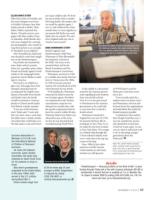
Hans Weinmann stops in front of two documents from
his childhood in Austria. One expels Jewish students
from non-Jewish schools; the other is a bus pass to
allow him to get to a Jewish school across town.
Honorees Bernie and Nina Kent
COURTESY HMC