

22 | OCTOBER 24 • 2019
I
n 1988, when my sister Carole Lasser
was 38, she was diagnosed with mul-
tiple meningiomas — benign brain
tumors. “It’
s not cancer,
” we were told. But
as the years moved on so
did the tumors and, while
they were not cancer, they
caused enough trouble: sev-
eral surgeries, procedures
and countless MRIs. They
eventually left her with a
recalcitrant left arm, which
ended her professional piano
playing career.
In fall 2015, Carole began having a hard
time. Walking was getting more difficult
and she needed to use a wheelchair more.
It was getting tougher to play the piano
with her right hand. In the beginning of
2016, she noticed a bump on her forehead.
We had a sick feeling one of the tumors
was growing. Carole’
s doctors recognized
she was not doing well.
We called Rabbi Joseph Krakoff, senior
director at Jewish Hospice and Chaplaincy
Network (JHCN). He suggested the newly
created LifeLinks program — home-based
palliative care for people not yet ready for
hospice. The program is designed to enable
JHCN to bring comprehensive and compas-
sionate palliative care directly to the home.
In February 2016, Carole’
s doctors told
her what we had feared. The tumors were
going to end her life and there was nothing
they could do about it. Surgery would only
make things worse. She should spend her
final months with the people who loved
her. The doctors prescribed hospice.
Rabbi Krakoff was among the first peo-
ple we told. He spent many hours with
Carole, talking about her situation, her
fears and helping ease her emotional pain.
He was there for us, her family, as well. On
June 26, 2016, Carole passed away. Not a
day goes by that I don’
t think of her.
Shortly after my sister died, my parents
created the Carole Jo Lasser (z”l) Music
Fund at JHCN to provide music visits to
home-bound patients. As of today, they
have created multiple other life enrich-
ments, including Tai Chi, salon services,
art, pet visits, guided meditation, massage
and reflexology, and a life-review and
memoir-writing project.
In fall 2018, Pamela Applebaum and
Andrew Echt of the Applebaum Family
Foundation offered me the opportunity to
serve as an Applebaum Fellow for JHCN.
While I had a huge appreciation of what
JHCN did for my sister, I had no sense
of the depth and scope of the agency as
a whole. Becoming a fellow gave me the
chance to learn and participate in the agen-
cy’
s activities firsthand.
I met with Rabbi Krakoff twice a month
to discuss every part of the organization
and attended many different types of meet-
ings. I helped JHCN put on two education-
al programs for potential donors and those
interested in learning more about the ser-
vices it provides. I spent a handful of hours
each month working as a fellow.
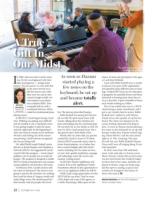
One of my initial visits was to a JHCN
client having a music enrichment, and I
got to see Carole’
s fund in action. Rabbi
Krakoff and I walked in with Hazzan
Daniel Gross who quickly set up his key-
board. The client was slumped on the
couch, looking exhausted and despon-
dent. As soon as Hazzan started playing a
few notes on the keyboard, he sat up and
became totally alert. Hazzan started sing-
ing “Henei MaTov,” and the man joined
right in. It. Was. Amazing. The man,
his wife, his son, Rabbi Krakoff, Hazzan
Gross and I were all singing along. It was
truly beautiful.
In 2018, more than 300 individual
music visits took place in homes across
Metro Detroit. Carole told me that music
was her best friend. She would be happy
to know that in her name, melodies are
played in homes, songs are being sung
and her spirt is soaring, as peace and
comfort are brought to the homes of
those who need it.
Marianne Bloomberg was the JHCN Applebaum
Family Foundation Fellow.
As soon as Hazzan
started playing a
few notes on the
keyboard, he sat up
and became totally
alert.
Marianne
Bloomberg
Special to the
Jewish News
Jews in the D
essay
A True
Gift In
Our Midst
The JHCN team brings music
enrichment to a client.
COURTESY JHCN