

46 | OCTOBER 17 • 2019
History of Food Safety
How one scientist helped end the century of the
‘
great American stomachache.’
SUZANNE CHESSLER CONTRIBUTING WRITER
W
hile doing research
for her most recent
book, science writer
Deborah Blum learned about
Nathan Straus, the Jewish
founder of Macy’
s.
At the turn of the 20th cen-
tury, Straus became a huge
advocate for pasteurized milk.
In New York during that time,
many children were dying from
milk-borne pathogens, and he
set up free pasteurized milk
stations.
“Nathan Straus doesn’
t get
enough credit for what he did,
”
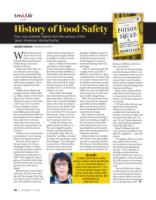
says Blum, author of The Poison
Squad: One Chemist’
s Single-
Minded Crusade for Food Safety
at the Turn of the Twentieth
Century (Penguin Group).
“I spend some time in my
book talking about the prob-
lems of unpasteurized milk and
how dangerous it was. Because
Straus had roots in Europe,
where they were much more
advanced in pasteurization, he
proactively used this issue to
save lives.
“Straus is one of my personal
unsung heroes. I love unsung
heroes and sing about them.
”
The hero at the center of
the new book is Dr. Harvey
Washington Wiley, a Purdue
University chemistry professor
named chief chemist at the
Department of Agriculture in
1883. Wiley began the investi-
gation of food and drink fraud
and did human tests on young
men known as the Poison
Squad.
Blum’
s book recounts Wiley’
s
work over 30 years, most nota-
bly with the passage of the Pure
Food and Drug Act of 1906. She
also calls attention to the jour-
nalists intent on exposing cor-
porate greed and government
corruption in efforts to evade
food safety measures.
Blum, a Pulitzer Prize-winner
and director of the Knight
Science Journalism Program at
the Massachusetts Institute of
Technology, will talk about her
book and current food safety
issues when she appears at the
Metro Detroit Book & Author
Society Luncheon to be held
Monday, Oct. 21, at the Burton
Manor in Livonia.
Other authors discussing
their latest projects include nov-
elist Susan Isaacs (Takes One to
Know One), memoirist Bridgett
Davis (The World According to
Fannie Davis: My Mother’
s Life
in the Detroit Numbers) and
New York Times TV critic James
Poniewozik (Audience of One:
Donald Trump, Television and
the Fracturing of America).
“I really love taking a for-
gotten moment in history, in
this case a largely forgotten
chemist, and returning him
to the public stage, where he
should be,
” says Blum, married
to retired arts and history writer
Peter Haugen. “I’
m really glad
to give Harvey Wiley another
moment in the sun because
he was so important to this
paradigm-shifting moment in
American history in which we
decide that the government
should engage in consumer
protection starting with food
and drugs.
“I like to remind people that
a single person can make a
difference, and Wiley is a great
example of that. At a time when
we can feel washed away by all
the political mechanics around
us, it’
s important to realize that
people who stand their ground,
hold to an issue and stubbornly
refuse to give up on what mat-
ters actually change things.
”
Blum, 64, and influenced to
study science by her entomol-
ogist father, Murray Sheldon
Blum, moved on to journal-
ism and graduated from the
University of Georgia.
She worked as a general
reporter before specializing in
science journalism as taught at
the University of Wisconsin,
which prepared her for cover-
ing important environmental
issues from Alaskan glaciers to
Hawaiian volcanoes.
Blum’
s books have included
The Monkey Wars about differ-
ing views on research animals,
The Poisoner’
s Handbook about
the development of forensic sci-
ence and Sex on the Brain: The
Biological Differences Between
Men and Women.
“I spend a lot of time looking
at history because I believe you
never understand where you are
until you also understand how
you got there,
” says the author,
whose personal religious history
is traced to Jewish heritage from
Germany and Russia.
Blum, whose books individ-
ually take less than three years
to research and write, feels her
release of The Poison Squad was
very timely.
“If I had written this pro-reg-
ulation book when Barack
Obama was president, it
wouldn’
t have had nearly the
traction of saying we really need
to preserve the safety net,
” she
says. “In the Trump administra-
tion, long-standing regulations
are being rolled back.
”
Blum’
s Michigan talk will
cover dramatic examples in the
fight for regulations — past and
present.
“I’
m going to talk some about
that myth of 19th-century
food, which is in the era before
any federal food regulations,
”
she says. “The University of
Michigan medical historian
Howard Markel and I were on a
panel together, and he describes
the 19th century as the century
of the ‘
great American stomach-
ache.
’
“We have labels now, which
we did not have in the 19th cen-
tury, and there’
s good informa-
tion on those labels. Our food
labels still are not as transparent
as I would like them to be.
”
MARK BENNINGTON
Deborah Blum
details
The Metro Detroit Book & Author
Society Luncheon will be held Monday,
Oct. 21, at the Burton Manor in
Livonia. Book sales begin at 11 a.m.
Lunch and speaker program start
at noon. Book sales continue after
lunch and during book signings. $40.
bookandauthor.org.
(586) 685-5750.
Arts&Life
books