

22 | OCTOBER 17 • 2019
Jews in the D
Mystery Solved
Samuel Pepys’
historic account of
Simchat Torah is fi
nally explained.
I
f you attend synagogue
only once, and your visit
coincides with Simchat
Torah, you would get a skewed
view of Jewish prayer. Most
synagogues relax the normal
rules of decorum for hakafot
(circuits), when people carry
Torah scrolls around the sanc-
tuary, accompanied by singing,
dancing and carrying on.
That happened to Samuel
Pepys (say it as “Peeps”) on
Oct. 14, 1663. Pepys, a political
leader and man-about-town
in London, decided to visit the
newly opened, and first legal,
synagogue in London.
The synagogue was a
new sensation because King
Edward expelled all Jews from
England in 1290. No Jews
were officially allowed until
Oliver Cromwell took steps to
welcome Jews in the middle
1650s. Jewish Londoners start-
ed Shaar Hashamayim shortly
thereafter. When Pepys visited,
going to synagogue promised
to be a new treat for the expe-
rience-hungry politician.
Back then, Pepys kept a
detailed diary of his activities
every single day, so we know
what happened that evening.
He saw men and boys wear-
ing tallitot (which he called
“vayles”), four or five of them
carrying the scrolls of Torah
(he called “Laws”). The con-
gregation sang the whole
service in Hebrew, except for
prayers for the king, recited in
Portuguese.
The experience disturbed
Pepys. He wrote, “But, Lord!
to see the disorder, laughing,
sporting and no attention, but
confusion in all their service,
more like brutes than people
knowing the true God, would
make a man forswear ever see-
ing them more and, indeed, I
never did see so much or could
have imagined there had been
any religion in the whole world
so absurdly performed as this.
”
Apparently, no one told him
that Jewish services look con-
siderably more decorous the
other days of the year.
This version of the history
leaves a few loose ends. Check
your calendar, and Simchat
Torah in 1663 should have
been Oct. 24, not Oct. 14,
when Pepys visited the syn-
agogue. On what other day
would Pepys see hakafot?
The columnist who goes by
the name Philologos solves
that problem: England still
used the Julian calendar back
then, so England stayed 10
days out of step with the rest of
Europe. Simchat Torah indeed
fell on Oct. 14 in England.
When England finally switched
to the Gregorian calendar in
September of 1752, it had to
make 11 days disappear.
But if Oct. 14 was Simchat
Torah, how did Pepys see
hakafot in the evening?
Synagogues around the world
do these circuits on the eve-
ning as Simchat Torah begins,
and on the morning of Simchat
Torah. Pepys arrived on the
evening as Simchat Torah
ended or after the end of the
festival!
Philologos solves that prob-
lem, too. Since at least the
middle-1500s, some congre-
gations had begun the practice
of having hakofot sheniyot
(second circuits) on the night
after the end of Simchat Torah.
Philologos knows of the prac-
tice because Rabbi Yitzhak
Luria (1534-72) opposed it, but
some later Eastern European
synagogues favored it. It seems
that Shaar Hashamayim had
second circuits.
Philologos concludes by
observing that, while the
practice of second circuits
hardly exists outside of Israel
anymore, it has become wide-
spread in Israel, often accom-
panied by musical instruments
that would not be welcome on
the festival itself.
This year, Simchat Torah begins the
evening of Monday, Oct. 21, at 7:24
p.m.
LOUIS FINKELMAN CONTRIBUTING WRITER
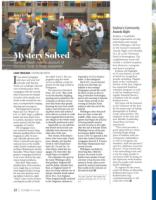
A festive Simchat Torah
at the Isaac Agree
Downtown Synagogue
from years past
BRANDON SCHWARTZ
Kadima, a Southfield-
based organization serving
individuals with mental
health challenges, will host
its 4th Annual Community
Awards Night event Monday,
Oct. 28, at the Townsend
Hotel in Birmingham. The
complimentary event will
include a cocktail reception,
hors d’
oeuvres, a program
and dessert reception.
Kadima will highlight
its 35-year history, as well
as hand out recognition
awards, including Flagstar
Bank as the Community
Partner of the Year. Flagstar
has supported Kadima’
s
volunteer program, as well
as had an employee lead a
regular financial literacy
workshop with the people
Kadima serves.
Jeff Aisen will be honored
as the Volunteer of the Year
for his many years of taking
photographs at Kadima
events and activities. The
employee of the year and
new Member Leadership
Award have not been
announced.
“This event provides a
great opportunity to share
exciting things taking
place at Kadima with our
community stakeholders,
as well as recognize our
members, staff and partners,”
said Eric Adelman, executive
director. “It has turned into
a fun networking event and
a way for many people to
reconnect while focusing on
the important work Kadima
does for people with mental
health challenges.”
To register for the event,
email Ali Huber at allisonh@
kadimacenter.org or visit
kadimacenter.org/
communityawards or call
(248) 663-4330.
Kadima’
s Community
Awards Night