

20 | OCTOBER 10 • 2019
T
he Torah tells us what
to do with a sukkah: “In
Sukkot you shall dwell
for seven days; every citizen
of Israel shall dwell in sukkot”
(Leviticus 23:42). Dwelling, as
the ancient rabbis understand
the term, means treating the
sukkah as one treats home the
other weeks of the year: “One
eats and drinks and walks
around and sleeps in the suk-
kah” (Talmud Sukkot 28b).
The Talmudic rabbi Rava
also derives one related lenien-
cy from the word “dwell”: One
does not stay in the sukkah if it
feels uncomfortable, just as one
would leave an uncomfortable
house (Talmud Sukkah 26a).
Feeling comfortable in
the sukkah seems just right
for this time of year in the
land of Israel, with generally
dry and temperate weather.
Feeling comfortable in a suk-
kah seems less likely in cold,
wet lands. Jews who want
to use the sukkah do put up
with a little discomfort.
About 30 years ago, a young
man from New York City
came to visit his wife’
s family
in suburban Detroit. That first
night on Sukkot, the family
put on their overcoats and
prepared to eat dinner in the
sukkah. The visitor objected:
“It is nearly freezing!” The host
replied, “You can decide you
feel uncomfortable in New York
City when it is nearly freezing.
If we used that standard here,
we would hardly ever use our
sukkah at all.
”
Few Detroiters tried to
sleep in the sukkah back then.
Sharon Krasner of Oak Park
recalls that her late husband
took all three children to sleep
in the sukkah decades ago. The
younger two came in at 3 a.m.,
complaining of the cold. Dad
and the oldest child stuck it out
until 6 a.m. Mom never tried.
Over the decades, the climate
in suburban Detroit has become
more hospitable to sleeping in
sukkah. People who do it now
give some helpful hints.
Larry Winer of Oak Park rec-
ommends having “a thin mat-
tress or padding and sleeping
bag. Pray it doesn’
t rain or snow
(actually fun when it does).
Expect to wake up very early.
”
You can keep off the ground
by using an air mattress. Caryn
Finkelman (my daughter-in-
law) recommends putting a
blanket between you and the air
mattress, “otherwise you are just
heating up the mattress.
”
I use a cot to keep me off the
cold hard ground and a sleeping
bag on top of the cot.
As we enjoy the brisk fall
weather in Michigan, we should
remember that some places
experience more intensive cold.
Former Detroiter Claude
Schochet, now in Israel, recalls
that when he was growing up
in Minnesota, they would leave
the sukkah if ice formed on the
surface of the soup.
Rabbi Ari Ellis of Oak
Park had lived in Winnipeg,
where “the average nightly
temperature for mid-October
hovers just above freezing at 36
degrees. We’
d bundle up.
“
A handful of members of
our congregation had the right
equipment (space heaters and
outdoor gear) and did sleep
in the sukkah. And while our
night-time temperatures are
a little more than 10 degrees
warmer, it’
s still quite cold.
“If it was 45 or 50 degrees
in our house (i.e. if the fur-
nace was broken or there was
a power outage), we would
endeavor to find somewhere
else to stay,
” Ellis said.
Brooke Weingarden, who
belongs to Southfield-based
Congregation Shaarey Zedek,
said she and her family set up
camp last year and slept in their
sukkah. “It’
s a chilly but won-
derful and fun family tradition.
I am grateful that we have a
strong sukkah to keep the wind
out. It feels like we are camping
in our driveway.
”
Over the centuries, some
rabbis have issued — pardon
me — blanket permission not
to sleep in the sukkah. Most of
these rabbis lived in cold parts
of Europe.
Sleeping in the sukkah feels
like an adventure, camping out
at home, getting to know your
natural neighborhood intimate-
ly. It also amounts to a whole-
body religious experience: feel-
ing exposed to the elements and
protected by the One who has
protected our ancestors. When
else can you do a mitzvah in
your sleep?
Jews in the D
LOUIS FINKELMAN CONTRIBUTING WRITER
Sukkah
Sleeping
The tradition of dwelling in a
sukkah for seven days can
include overnight stays.
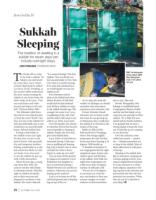
COURTSY OF BROOKE WEINGARDEN
TOP: The Weingarden
family sukkah. LEFT:
Maya Weingarden
slept in the sukkah
last year.