

SEPTEMBER 26 • 2019 | 89
A hallmark concert, running
Oct. 4-6, restages the first 1919
program. Michael Francis will
conduct Weber’
s Overture to
Oberon, Mozart’
s Double Piano
Concerto in E-flat Major with
pianists Christina and Michelle
Naughton, Bach’
s T
riple Piano
Concerto in C Major with
the Naughtons and pianist
David Fung and Beethoven’
s
Symphony No. 5.
Violist Glenn Mellow, who
is beginning his 40th season
with the DSO, enthusiastically
joined in as the orchestra began
rehearsals in September for the
commemorative programs.
“I deeply love music and can’
t
imagine my life without it,”
says Mellow, who moved from
violin to viola while attending
Northern Illinois University and
before earning a master’
s degree
from Indiana University.
“
After we played the first
movement of Beethoven’
s fifth
symphony, I knew that it still
thrills me beyond words as a
benchmark piece.
“While it is exciting to be
in the center of that sound, it’
s
been just as exciting to play
other great music among people
for whom I have great respect.
Orchestra Hall is extraordinary,
and the sounds come out clear
and warm; it’
s like another
instrument.”
Mellow, a
member of the
Birmingham
Temple in
Farmington Hills,
can recall many
special concerts
and looks back on one attended
by his mother, who traveled
from Chicago to see him on
stage with Itzhak Perlman.
To recognize the many pops
concerts held over the years,
another commemorative pro-
gram, “
A Century of Pops,” will
feature assistant principal cellist
Abraham Feder as a soloist. The
free concert, to be held Oct.
23 and requiring reservations,
is on the anniversary date of
Orchestra Hall’
s 1919 grand
opening.
The program, which also fea-
tures conductor Leslie Dunner
and mezzo-soprano Danielle
Wright, includes selections from
the first pops program and
moves into later DSO perfor-
mances to highlight Broadway
and film favorites.
Feder, marking his first anni-
versary with the DSO, says, “I’
ll
be playing Kol Nidre by Max
Bruch and Symphonic Variations
by Leon Boëllman to recreate
two pieces played by a solo cel-
list in that first year.
“The Boëllman piece is a
wonderful showcase for the
cello and features variations on a
beautiful theme. I’
m most excit-
ed about Kol Nidre. I’
ve played
the piece at synagogue for Yom
Kippur, many times with organ,
so it will be such a thrill to per-
form Bruch’
s gorgeous orches-
tration with the DSO.”
Feder, who holds degrees
from the Curtis Institute of
Music and Rice University’
s
Shepherd School of Music,
joined the orchestra after posi-
tions in the Dallas Symphony
Orchestra and the Sarasota
Orchestra. He currently holds
the Dorothy and
Herbert Graebner
Chair with the
DSO.
“My parents
are coming from
Chicago to hear
Abe Feder
Glenn Mellow
details
To get complete
programming information for
the 2019-20 season of the
Detroit Symphony Orchestra,
go to DSO.org or call
(313) 576-5111.
continued on page 92
DSO
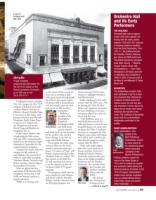
A view of
Orchestra Hall,
May 1920
Orchestra Hall
and Its Early
Performers
THE BUILDING
Orchestra Hall, with an approx-
imate 2,000-seat capacity con-
tinuing over the years, closed
between 1939 and 1941 because
of financial problems resulting
from the Great Depression. From
1941-51, the building became
the Paradise Theatre, featuring
jazz, blues and R&B performers.
The Detroit Symphony Orchestra
used other venues — Masonic
Temple Theatre, Music Hall,
Ford Auditorium — from 1939,
throughout a dormancy and until
a restoration was completed in
1989. In 2003, it became part of
the Max M. and Marjorie S. Fisher
Music Hall.
ACOUSTICS
The outstanding acoustics have
been attributed in part to a shoe-
box structural style, allowing for
a balance of direct sound and
indirect sound. Its mid-size also
was important. A tower above the
stage and an empty room below
enhanced the warmth of the
music. The hardness of the plaster,
joined with the ornamentation,
additionally contributed to the
quality.
OSSIP GABRILOWITSCH
Ossip Gabrilowitsch, who
studied at the
Saint Petersburg
Conservatory, record-
ed many pieces for
the reproducing piano
before becoming
conductor of the
Munich Philharmonic.
Political problems caused his
move to the United States in
1914, and he worked as a pianist
and conductor before joining the
Detroit Symphony Orchestra. In the
1919-20 season, Gabrilowitsch
hosted many famous musicians,
such as violinist Mischa Elman,
cellist Pablo Casals and pianist
Arthur Rubinstein.
DSO
Ossip
Gabrilowitsch