

86 | SEPTEMBER 26 • 2019
News from Israel
Eretz
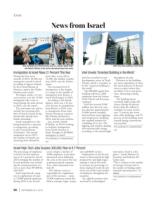
New immigrants from North America arrive on a special “Aliyah Flight”
with Nefesh B’
Nefesh at Ben Gurion International Airport last month.
During the first seven
months of 2019, 20,506 new
immigrants arrived in Israel,
according to figures released
by the Central Bureau of
Statistics, reports the Globes
business news outlet.
The figure marks a 21 per-
cent increase over the 15,965
immigrants who came to
Israel during the same period
in 2018, says the report.
The newcomers are said to
include the returning chil-
dren of Israeli citizens living
abroad who already have
Israeli citizenship.
Israel’
s population is also
being boosted by a decrease
in emigration, according
to the Central Bureau
of Statistics. The annual
emigration rate in 2017,
the number of Israelis not
returning from abroad for
more than a year, fell to
14,300, the smallest number
since 2010, says the Globes
report.
The increased level of
immigration is due largely
to a surge in the number of
immigrants from Russia, a
trend which began in 2018.
According to the Jewish
Agency, there was a 45 per-
cent increase in immigration
from Russia in 2018, even
as immigration from other
Eastern European countries
like Ukraine declined in
2018, said the news website.
Last month, Nefesh
B’
Nefesh, an NGO working
to facilitate immigration
from North America to
Israel, brought its 60,000th
immigrant to Israel.
First published on UnitedwithIsrael.
org.
Immigration to Israel Rises 21 Percent This Year
Intel’
s new smart building in Petah Tikvah
INTEL
NEFESH B’
NEFESH
Intel has unveiled its new
development center in Petah
Tikvah, which it considers to
be the “smartest building in
the world.”
The 800,000-square-foot
building will host 2,000
employees from the former
Petah Tikvah and Ra’
anana
campuses.
Intel has invested $180
million into the new cam-
pus that has approximately
14,000 sensors installed
that facilitate smart lighting
and temperature, doubling
the standard number for
a building of its size. The
lighting and window shading
will automatically change
according to the natural light
throughout the day.
Elevators in the building
use smart algorithms to learn
the travel patterns of elevator
users to expect where they
are likely to be at any given
time, shortening waiting
times.
The building boasts
extremely high energy effi-
ciency, fairing 40 percent
better than the industry’
s
standard. Its water system
uses 75 percent less water
than other buildings, and 95
percent of the building waste
created during construction
was recycled.
First published on UnitedwithIsrael.
org.
Intel Unveils ‘
Smartest Building in the World’
The percentage of employees
in Israel’
s hi-tech industry
rose to 8.7 percent by end of
2018, bringing the number of
hi-tech positions (not includ-
ing the communications sec-
tor) to more than 307,000 by
mid-2019.
Israel experienced a steep
rise in employment of close
to 19,000 salaried employees
during 2018 in the hi-tech
sector, despite a decline of
3,000 employees in the phar-
maceutical sector following
the crisis at the end of the year
at pharmaceutical company
Teva, when thousands were
laid off.
The software sector is
responsible for a significant
part of the increase — some
14,000 employees joined this
field at startups, larger compa-
nies and R&D centers.
Employment in the hi-tech
sector is characterized by high
productivity and high wages,
making it critical for Israel
to increase the percentage of
those employed in the hi-tech
sector out of the total number
of employees throughout the
economy.
“In a global economy char-
acterized by technological
innovation, Israel is a key
player,” Israeli Minister of
Economy and Industry Eli
Cohen said.
“This is evident in the number
of startups in Israel and in
the number of leading multi-
nationals operating here,” he
added.
First published on worldisraelnews.
com.
Israeli High-Tech Jobs Surpass 300,000, Rise to 8.7 Percent