

6 | SEPTEMBER 19 • 2019
I
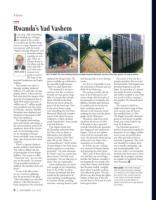
t sits atop a hill overlooking
the bustling city of Kigali,
the capital of the country.
As you drive up, the first thing
you see is a large, dramatic arch-
way entrance with the words
“Kigali Genocide Memorial” and
Rwandan soldiers
standing on each
side. There are
Kleenex boxes in
the lobby, and the
ticket lady tells
us to take some
because we’
re
going to need it.
We strap on the
provided headphones and begin
walking.
The somber tour takes us
through winding, darkened
hallways. On each side, we pass
graphic photos, videos and arti-
facts that detail the massive tribal
genocide that happened here in
April 1994 when more than 1
million out of 7 million people
were murdered over the course
of 100 days. Another 200,000
Rwandans were displaced and
hundreds of thousands of chil-
dren were orphaned.
The displays hold nothing
back and include such things as
the actual machetes used by the
murderers, shoes of the victims
and, in one haunting room,
we see hundreds of human
bones and skulls, many bearing
large, open fractures from those
machetes.
There’
s a separate children’
s
section, similar to Yad Vashem.
The walls are filled with lots
of photographs of once-happy
children. The section is called
“Tomorrow Lost.” As you enter,
you see the words: “In memory
of our beautiful and beloved
children who should’
ve been our
future.”
In one of the film rooms
we see a survivor explaining
that the memorial is the place
“where Rwandans can visit their
relatives.” One film features a
bride and groom who were both
orphaned by the genocide. The
groom tearfully says celebrations
are especially tough because
“there’
s no adult family left.”
The memorial is not just a
museum, but also a cemetery.
Outside are mass graves, huge
slabs of concrete that entomb
about 250,000 of the dead.
Flowers are strewn along the
graves, left by loved ones. Next
to the graves looms a huge
wall, resembling the Viet Nam
Memorial, filled with countless
names of the dead. Everyone
walking by is silent, shocked,
numb, heartbroken. Some people
need that Kleenex.
One display details how
the Rwandan authorities from
the Hutu tribe set about to
dehumanize and ethnically
cleanse members of the T
utsi
tribe. We see the “Hutu 10
Commandments,” which includ-
ed such things as “no T
utsi wives,
business partners or secretaries
permitted,” “no more education
for T
utsis,” and “you cannot loan
them money.” The final cruel
inscription: “Do not take pity on
them. They are cockroaches.”
Upon reading that, my mind
went straight to the Nuremberg
Laws in the 1930s, in which
Germany proclaimed that Jews
would not be permitted to do
most anything, including going
to German schools, marrying
non-Jews, entering theaters, parks
and skating rinks or even driving
nearby.
As a Jew, it’
s impossible to tour
the memorial in Rwanda and not
think of the Holocaust.
One section actually tells the
story of the Holocaust in two
rooms, along with the stories of
the genocides in Cambodia, the
Balkans, Namibia and Armenia.
(I couldn’
t turn my head away
from watching a group of
Africans in the museum closely
studying the story and the photo-
graphs of the Holocaust.)
This place, aside from teach-
ing about the horror of 1994
in Rwanda, is also a powerful
reminder that full-scale genocides
have happened and continue to
happen. They are not isolated
events and not necessarily past
tense. No particular ethnic group,
neither Jews nor others, has a
monopoly on its suffering.
Its victims are vast, crossing
over centuries of human history
and spanning the entire plane.
This is one of those places you
visit and then can never forget,
just like Yad Vashem. Actually, it
was inspired by two people who
visited Yad Vashem and decided
that Rwanda needed a tangible
place where its people could go
and collectively grieve. The peo-
ple here say that facing the ugliest
chapter of their past is the best
way for them to heal and to teach
future generations.
The nation is now run by a
popular president who once led
the T
utsi rebels. Paul Kagame has
preached forgiveness and soli-
darity.
It’
s somewhat of a miracle
that today Rwanda is bustling
and widely accepted as one of the
true jewels in Africa, earning it
the moniker “the Switzerland of
Africa.”
The country’
s rebirth is a
bright and positive sign of hope,
yet it cannot erase the horror
that unfolded here in 1994.
The Kigali Genocide Memorial
preserves that horror in graphic
detail, just as Yad Vashem cap-
tures the Holocaust.
The Rwandan genocide is
another monumental tragedy for
humanity. It’
s not bigger, smaller,
worse or any less painful than
any other genocide in history.
Genocide is genocide. They can’
t
and shouldn’
t be ranked. Each
one is equally catastrophic, vile
and incomprehensible. And
each one, sadly, is an inescapable
reminder that from time to time,
despite all our progress, humans
are capable of completely losing
their humanity.
Mark Jacobs is the AIPAC Michigan
chair for African American Outreach,
a co-director of the Coalition for Black
and Jewish Unity, a board member
of the Jewish Community Relations
Council-AJC and the director of
Jewish Family Service’
s Legal Referral
Committee.
Views
Mark Jacobs
PHOTOS COURTESY OF MARK JACOBS
essay
Rwanda’s Yad Vashem
LEFT TO RIGHT: The front archway entrance at Kigali Genocide Memorial; The site of the mass graves; The wall of names.