

SEPTEMBER 12 • 2019 | 63
prayers from several religions to
convey the message of coming
together.
“Prayer” is the song that
holds the most meaning for
music supervisor, arranger and
sometimes onstage conductor
Ian Eisendrath,
38, who graduated
from the University
of Michigan. He
focused on con-
ducting for choral
and musical the-
ater repertoire and has specialized
in new musicals.
“‘
Prayer’
is a compilation of
real prayers that existed in the
public domain,” says Eisendrath,
who accepts most of the Jewish
belief system as impacted by a
Jewish mother and a father who
is of Jewish descent.
“The idea is to tell the
story of how the interaction
of multiple faith groups in
Gander learned to reach across
what might be dividing lines.
We hear these prayers sung
simultaneously, a metaphor for
how these faiths can coexist in
harmony.”
The songs, he explains, have
Celtic and folk-rock influences
that reflect the Canadian area
where the production is set.
Sankoff and Hein, who met at
York University in Toronto and
developed a friendship through
theater studies before professional
collaboration, have a very per-
sonal connection to the subject
they have staged.
“We were living in New York
on 9-11, and my cousin was in
one of the towers and fortunately
got out,” Hein says. “We didn’
t
want to tell a 9-11 story; we
wanted to tell a 9-12 story about
the people we’
d fallen in love
with in Newfoundland.
“One of the reasons I think
it resonates so much with us
was because on 9-11 we were
living in a residence for inter-
national graduate students with
people from 110 countries, and
we were in a community of
people from around the world
taking care of each other.
“Obviously, we’
re proud of
the story of Canadians, but
what we’
re seeing now with five
companies is that on this day,
we wanted to come together
and be good to one another.”
The couple, nominated for
Tony and Grammy Awards, is
excited the story they developed
is in movie development. With
film, audiences can watch what
it looks like for 38 planes to land
and bring some 7,000 people
from different countries into a
town of about 10,000.
A companion book — Come
From Away: Welcome to the Rock
(Hachette Book Group) — is
coming out Sept. 24 and will
include the script and songs as
well as material cut from the
show. Canadian Prime Minister
Justin Trudeau wrote the fore-
word.
With all their collaboration
— in marriage, parenting of
one daughter and work —
Sankoff and Hein believe in the
power of communication to
resolve differences.
“It’
s open communication as
much as possible,” she says. “It’
s
also trying to foresee problems
before they happen.”
Ian Eisendrath
WALTER MCBRIDE
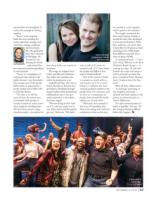
Come from Away
creators Irene Sankoff
and David Hein
A lively musical
number from
Come from Away