

September 5 • 2019 41
jn
bullied by his peers and rabbis at the
yeshivah he attended. He writes about
growing up in a Syrian Orthodox Jewish
community in Brooklyn, his special rela-
tionship with his mother, the challenge
of being gay and rising to the top of the
fashion world.
Detroiters can learn more about
Mizrahi’
s upbringing, career and the
world of haute couture on Tuesday, Sept.
10, at Congregation Shaarey Zedek, when
he will be the guest speaker at Hadassah
Greater Detroit’
s Judi Schram Annual
Meeting. The
event, which includes
30 boutiques open free to the public,
is named for longtime local Hadassah
leader Judi Schram, who died in 2017.
Funds raised will benefit critical needs at
Hadassah Medical Organization in Israel.
Sherry Margolis, news anchor at Fox 2,
will ask Mizrahi questions, and then the
audience will be invited to participate.
Mizrahi says he hopes many of the
questions will be about his childhood
and his memoir, which will be sold at
the event. “I will I start off by giving an
overview of the book — I want people
to know who I am,
” says Mizrahi, 56. “I
hope my experiences will resonate with
the audience.
”
As a young boy, Mizrahi thought his
calling was show business. “When I was
about 7 years old, I went to see Funny
Girl with my family and was so inspired
by Streisand I started imitating her,
”
recalls Mizrahi, who attended a yeshivah
from kindergarten through eighth grade.
“I impersonated Judy Garland and Liza
Minelli, and I would do these female
impressions inappropriately in places like
the lobby of shul!”
DRAWN TO FASHION
But it was designing clothes for the rich
and famous that made Mizrahi a house-
hold name. When he entered the High
School of Performing Arts in New York
City, his focus was the entertainment
world. However, by the time he was a
junior, he switched gears and found a bet-
ter way to express himself.
“I realized all my friends were gor-
geous, thin, blond and movie star types; I
was fat and I didn’
t have that self-image,
”
he says. “So, I rethought my career and
decided to work in the fashion industry. It
enriched me so much and gave my life a
different kind of story and platform.
”
His interest in the world of fashion
didn’
t come from out of the blue. His
father was a children’
s clothing manufac-
turer, and Mizrahi, who loved reading
fashion magazines, had sewing machines
at his disposal.
“I started to make puppets and sew
clothes for them,
” recalls Mizrahi, who
added that he liked doodling sketches
of outfits in the margins of his Hebrew
books. “By the time I was 10, I had this
big puppet theater in the garage, and
I made their clothes. My father had sew-
ing machines everywhere and he taught
me how to sew. By the time I was 13, I
was a really good sewer, and I started
making clothes for my mom and myself.
It became this fun, compelling thing. My
mom (who is in her 90s) was really into
fashion and encouraged my interest.
”
After high school, Mizrahi attended
Parson’
s School of Design in New York
City. His first fashion job was working
at Perry Ellis, then with designer Jeffrey
Banks, then Calvin Klein. Along the way,
he honed his skills — selecting fabric,
participating in design meetings and
sketching clothes. By the time he was 26,
he went out on his own.
In 1989, he presented his first show,
which catapulted him into fame and his
couture soon dominated the fashion
mags. He dressed celebs for red carpets,
and his clients have included Michelle
Obama, Meryl Streep, Hillary Clinton
and Oprah.
“Barbra Streisand was so lovely,
” he
recalls. “I tailored a suit for her and
Woman’
s Wear Daily erroneously attribut-
ed it to Donna Karan. Barbra wrote me a
note saying, ‘
We know who really made
this suit!’
”
WEARING MANY HATS
But this fashion designer’
s enormously
successful journey had its highs and
lows. He made countless guest appear-
ances on television and in the movies.
He earned an Emmy nomination for
Best Costume Design for his work in
Liza Minnelli Live. He was the subject
of the critically acclaimed documen-
tary film Unzipped, which chronicled
his 1994 collection. And he’
s a cabaret
singer.
Despite being one of the world’
s most
beloved designers, the company was
losing money and closed after his fall
1998 collection. Still, he returned to
fashion in 2002, teaming up with Target
and becoming one of the first high-end
designers to create affordable clothes for
the masses. In 2009, he launched his life-
style brand ISAACMIZRAHILIVE! sold
exclusively on QVC. In 2011, he sold his
trademark to Xcel Brands.
Among his many credits, he hosted
The Isaac Mizrahi Show for seven years;
he wrote two books; in 2016, he had an
exhibition of his designs at the Jewish
Museum in New York. Currently, he sells
on QVC and Lord & Taylor, and serves as
a judge on Project Runway: All-Stars.
When asked what he’
d like his legacy
to be, he referred to his Judaism. “My
name is Isaac, which means laughter in
Hebrew,
” says Mizrahi, who considers
himself a cultural Jew. “I think, most
importantly, I want my legacy to be about
humor.
”
Nevertheless, he added that he’
s
“obsessed with obituaries” and the first
thing he does when he reads the New
York Times is look at the obituary page.
“I have dreams about my obituary,
” he
admits. “
Although the New York Times
probably already has it written (as they do
for famous people) and revises it as time
goes on, I hope I can live longer to add
more things. I want people to know I
had integrity, and what my life really
stood for.” ■
“I rethought my career and
decided to work in the fashion industry.
It enriched me so much and gave my life
a diff
erent kind of story and platform.”
— ISAAC MIZRAHI
details
Isaac Mizrahi will speak at 1 p.m.
Tuesday, Sept. 10, at Hadassah’
s annual
fundraising meeting at Congregation
Shaarey Zedek in Southfield. Speaker-
only tickets are still available at $50.
A private reception with Mizrahi is at
11 a.m.; tickets are $230 including his
speech. The deadline to register for the
luncheon has passed. More than 30
boutiques are open free starting at 10
a.m.-3:30 p.m. (with a pause for the
speaker), with 15 percent of proceeds
going to Hadassah. For tickets, call
(248) 683-5030 or register online at
Hadassah.org/detroitevents.
DAVID ANDRAKO
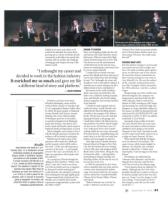
Mizrahi goes back to his performing roots when he does
cabaret singing, sometimes at Cafe Carlyle in New York City.